Can you believe it?

mike weeks

Suspended / Banned
Messages
4,881
Name
mike
Edit My Images
No
After the threads about the poor images used in advertising here is another in the same manner

This has the potential to be a really educational article but there are just too many mistakes

"The only difference now is that we can control the amount of light emitted by the flash electronically and with incredible accuracy." except they fail to mention that that is IGBT flashes and of course Elinchrom are not IGBT

The flash duration used in the animated examples is far far longer than your normal flashgun, these pulses look even longer than my 20 year old Bowens lights. For most normal flashguns the flash pulse will be mush shorter than the X-Sync speed of your camera. (Elinchrom had to go away from their normal short duration to build a long duration flash to make HS work - of course that means the power is delivered over a longer time i.e. the peaks can not be like in the diagrams)

This is really subjective "By accessing higher shutter speeds, we can overpower daylight with less power output (or from farther away) and we also have" why? a flash pulse has a defined length, use a shorter shutter speed and you cut both the ambient and the flash i.e. it does not overpower more

The article has "Hi-Sync also offers more options than any other flash technology because you have more light output at your disposal and no gradation." and "When using HyperSync with Nikon at shutter speeds higher than 1/1600th sec, a gradation like this is common. With Elinchrom’s Hi-Sync technology, there are almost no gradation visible." - so which one is right?

Sorry mr marketing man but you have delivered an interesting product because independent tests support most of what you say about specifications but your write up falls short of your gear

http://www.elinchrom.com/learn/hss-hs.html
 
The actual results I have seen certainly speak for themselves, but the explanation could be better.

That said, if I manage to find something that does what I want it to, I'm not that fussed if it isn't fully explained. I'll soon find the boundaries, and I'll prod for any workarounds.
 
The actual results I have seen certainly speak for themselves, but the explanation could be better.

That said, if I manage to find something that does what I want it to, I'm not that fussed if it isn't fully explained. I'll soon find the boundaries, and I'll prod for any workarounds.


It looks to me like the old problem of marketing vs engineering

From what I have seen it does the job but not as described

Mike
 
The claimed light output advantage over established tail sync technique is of definite interest, and I've spoken to a few photographers who have used it. I've also seen some results that certainly appear more evenly lit.
Not entirely sure how much tinkering is required to set it up to maximise the benefit.

Might be worth a play.
 
The claimed light output advantage over established tail sync technique is of definite interest, and I've spoken to a few photographers who have used it. I've also seen some results that certainly appear more evenly lit.

To paraphrase Hoppy their example photographs are all taken in circumstances where it is not noticeable or certainly not obvious,

Mike
 
To paraphrase Hoppy their example photographs are all taken in circumstances where it is not noticeable or certainly not obvious,

Mike

I have to say, the lighting is actually there on the BMX rider images, but it's also extremely subtle. And if I were to be honest, when explaining new technology or a new technique, subtlety isn't the best trait to utilise.
There are far more striking images floating about, with quite dramatic lighting that is self-evident.

The image at the top of this page, for example.

And here, a much better collection.

Interesting article on FStoppers comparing Profoto HSS and Elinchrom HS. The colour shift is quite noticable, and the power output results were quite interesting when compared too.
The article is four months old.
 
To paraphrase Hoppy their example photographs are all taken in circumstances where it is not noticeable or certainly not obvious,

Mike

Something like that :) Elinchrom's marketing images look terrific and show what the kit can do - as you would expect, and nothing wrong with that at all.

But if they are over-egging the pudding, they will come unstuck when people buy an outfit and find it isn't performing quite how they hoped. Elinchrom has certainly not explained or demonstrated the downsides of tail-sync, and they are as real as the upsides.

Also, because some of the images look so good, and in the absence of full technical explanations, I don't think it's unreasonable to speculate a bit. In no particular order, what camera is being used? I know Eli has been using Canon 1DX for demos, and that will give much better results than say a 5D2. Are we seeing the whole, unretouched* frame? How heavily have they been cropped? What was the ODS timing advance? Has the camera been turned upsidedown? Has inverse-square law fall-off been used to counteract the fading tail of the flash? All legitimate techniques, but with something as technical as this, with results that can be so variable, we need to know.

*Check that image of the roller-blade guy against the smokey background that Michael S linked - what's that lighter line under his leg/bum? And there's a darker line above his right arm that is not a flash effect, not to mention the area of background under his arm that the retoucher forgot to darken... ;) This pic http://www.elinchrom.com/skyport/PlusHS.html
 
Watching the video at 1.14 , It appears to show the main flash frame left and is easily seen as the key in the promotional image, and I think that's putting the skater's left arm in shadow from his torso. (?)
As for the rim light along his butt and side, I can't make out if there's a flash that catches it or not.

So is it possible we aren't seeing the capture of the promo image?

It really has got me intrigued, and I'm thinking I might just like to have a play
 
Watching the video at 1.14 , It appears to show the main flash frame left and is easily seen as the key in the promotional image, and I think that's putting the skater's left arm in shadow from his torso. (?)
As for the rim light along his butt and side, I can't make out if there's a flash that catches it or not.

So is it possible we aren't seeing the capture of the promo image?

It really has got me intrigued, and I'm thinking I might just like to have a play

I'm looking at the skater's right arm, clearly lit by the flash, where there's a slightly darker and very fine line on the top edge of his forearm. It's not 100% evidence of retouching, and neither is the fact that the area of background visible under his right arm looks too light, as if it's been missed ;) Neither of those things is 100% conclusive, but the lighter line under his butt, that actually extends quite a long way, is very suspicious of a local darkening effect being applied to the bottom half of the image in post processing, then being rather clumsily cut-out around his body with a feathered edge. I know exactly what that looks like - I do it all the time :D

I've not looked closely at many of the other sample images - they all look plausible enough at first glance and a bit of smoke and mirrors is, I think, part of the marketing game. And you can do some cool things* with this kit. But there are downsides to it as well, and Elinchrom should own up to that. Then we can all be winners, playing to its strengths, but working within its limitations. However, if blatant retouching is part of the game, then, well, I'll not waste any more time looking too closely at anything else. That's going too far and who knows what we're seeing.

*Basically, with the right subject and situation, with the right camera and the right techniques and workarounds employed, you can get significantly more effective brightness out of the Elinchrom HS kit than you can a similar powered HSS head. And that can be a very valuable asset. But it's not magic, and it's not new either. What Elinchrom has done is make what used to be a highly specialised technique, needing particular knowledge and equipment, into something much more accessible and pretty much plug-in and play. Credit for that at least :)
 
Last edited:
I'm looking at the skater's right arm, clearly lit by the flash, where there's a slightly darker and very fine line on the top edge of his forearm. It's not 100% evidence of retouching, and neither is the fact that the area of background visible under his right arm looks too light, as if it's been missed ;) Neither of those things is 100% conclusive, but the lighter line under his butt, that actually extends quite a long way, is very suspicious of a local darkening effect being applied to the bottom half of the image in post processing, then being rather clumsily cut-out around his body with a feathered edge. I know exactly what that looks like - I do it all the time :D

I've not looked closely at many of the other sample images - they all look plausible enough at first glance and a bit of smoke and mirrors is, I think, part of the marketing game. And you can do some cool things* with this kit. But there are downsides to it as well, and Elinchrom should own up to that. Then we can all be winners, working within its limitations. However, if blatant retouching is part of the game, then, well, I'll not waste any more time looking too closely at anything else. That's going too far and who knows what we're seeing.

Ah, now I see it.
Yes, the light under his bum that I thought you were referring to, is actually the background smoke, and not his bum, and a definite failure to burn.

*Basically, with the right subject and situation, with the right camera and the right techniques and workarounds employed, you can get significantly more effective brightness out of the Elinchrom HS kit than you can a similar powered HSS head. And that can be a very valuable asset. But it's not magic.

If this is the ball pein hammer, when all I have normally are lump hammers, I reckon I can find a use for it ;)
 
Ah, now I see it.
Yes, the light under his bum that I thought you were referring to, is actually the background smoke, and not his bum, and a definite failure to burn.


If this is the ball pein hammer, when all I have normally are lump hammers, I reckon I can find a use for it ;)

:)
 
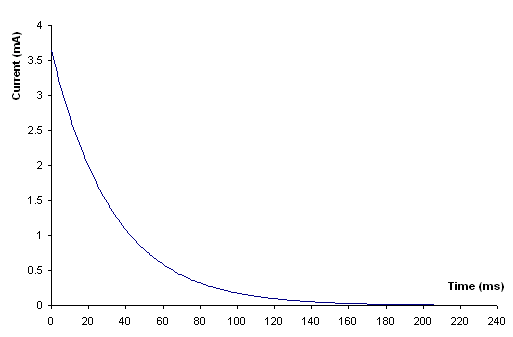
The graphs they use in the article are incorrect and misleading. They show an almost linear fall off of output over time. As the light output is effectively the discharge curve of a capacitor, it looks more like this:-

EUxeu.gif


So called "hyper-sync" and their own "Hi-Sync" do not start at the peak light output as they show on their graphs. It's tail sync. It uses the tail end of the light when the discharge curve is flatter. If you did start the exposure at the peak, the fall off of light across the frame would be quite extreme. Typically around half of the light output is wasted before the shutter opens, and again, most of what comes out during the exposure bounces off the shutter curtains. The ability to adjust the timing is not unique to this system, or new - the YN622TX allows you to shift the exposure window about. The only real advantage I can see with the ELB 400 is that they managed to make a really slow flash head, with a flatter output curve.

Sorry Elinchrom, but the idea that your "Hi-Sync" is in any way different to any other tail sync is pure Snake Oil, and many vendors including Yongnuo beat you to it:-
http://owenlloydphotography.com/?p=1657

They didn't need to make these erroneous claims either: it obviously works as well or better than most tail sync combos judging by the results and the very slow ELB 400 head helps a lot. However, If they really wanted to demonstrate the difference in fall off between their system and others, they should have shot a grey background as they did for the "regular" tail-sync so people could see a direct comparison.

The whole article is pretty sloppy tbh: they were doing pretty well until this bit: "When shooting with strobes, the aperture controls the brightness of the light on your subject and the shutter speed controls the brightness of the background.". Oh dear. Another supposed group of experts who somehow think the ambient light becomes immune to the aperture size if you also use a flash.

and...

"By accessing higher shutter speeds, we can overpower daylight with less power output". <sigh> really Elinchrom? And you guys make flash lights, right? As with with all flash-at-high-shutter-speed techniques, most of the light bounces off of the shutter curtains and is wasted. See the animations in your own article!
 
The only real advantage I can see with the ELB 400 is that they managed to make a really slow flash head, with a flatter output curve.

They had to otherwise it would not work, so glad to see somebody else that can really identify the issues in that article, it has to be one of the most technically inaccurate allegedly technical articles that I have ever read.

Mike
 
The graphs they use in the article are incorrect and misleading. They show an almost linear fall off of output over time. As the light output is effectively the discharge curve of a capacitor, it looks more like this:....
I've seen actual measured curves that looked similar to the one they show... but the rest I agree with you about. It's just a bunch of marketing nonsense...
 
Back
Top