

Calling in the big guns. UPDATE: Video with test firing added

Tyke Tiler

Suspended / Banned
Messages
3,980
Name
Tomas
Edit My Images
No
Over the last couple of months I have been thinking of buying a much larger scale lighting set up for shooting larger scenes outdoors.

I had been thinking the same last year but had to drop the idea due to the cost.

Head and battery packs would be awesome, but I simply can't afford those kind of prices and after reading about a few shooters using monoblocs with petrol generators it seems that there are potentially much more affordable options out there, but as I'm quite new and very inexperienced to the idea there's probably a fair few elements to seriously consider before spending any cash. Half, if not more of my budget is sectioned for modifiers and diffusion.

So far I'm looking at a 2.2 kilowatt gasoline powered generator running something like a Walimex VC-1000 (250w) as a key light and around three (borrowed) Elinchrom FX-400 (150w?).

I remember reading that 'pure sine wave' generators are a must for powering heads in this way.

Is this a requirement that relates to a particular brand of lighting ie profoto or are all heads needing a pure sine wave generator? Or is it only heads that use the battery packs?
Is the generator I'm looking at pure sine wave (I know the details are in Finnish, but maybe there is a universal symbol or text for pure sine wave?)

:thinking:

Surely a standard studio light that plugs into the mains at 230V can run off a gasoline generator boasting the same 230V?

The generator I'm looking at has a constant 2 kilowatt output, I don't plan on running anymore than 1.5 kilowatts through it.

My concerns reside in whether this will work, the specifics on making it work and not how practical it is TBH. The more practical the solution the more unaffordable it gets for me.

If anyone can help out or advise I'd be very grateful.

Cheers.
 
Tomas, any reason you want to run off a generator rather than a battery pack?

I built my own battery pack and take my Alien Bees lights if I need to go mobile. It's only a large Sealed Lead acid battery and a pure sine inverter. I store the whole lot in a Lowepro Magnum 35 Bag. Total Cost was around £140 for the kit.
 
Tomas, any reason you want to run off a generator rather than a battery pack?

I built my own battery pack and take my Alien Bees lights if I need to go mobile. It's only a large Sealed Lead acid battery and a pure sine inverter. I store the whole lot in a Lowepro Magnum 35 Bag. Total Cost was around £140 for the kit.

Sounds interesting Barney, Although I'd love some AB gear the main reason was the cash TBH, I hadn't thought of making a battery pack but importing all the Alien Bee heads would cost a fortune over here, the VAT is 22% and then there would be customs charges too.

Alternative heads are still too expensive, I need at least 1000 watt seconds of power for my main light and 5oo euros for the Walimex VC-1000 is a damn good price and I've already had the quality confirmed by a couple of mates over here.

Running a generator costs some 20-30 euros for 11 hours power at 2 kilowatts.
I can also power my laptop when shooting tethered too.
 
Sorry Tomas, I don't think I was clear. The battery pack outputs 240v (or whatever your Inverter outputs) so will power any 240v lights or your laptop as well. It may not be the best option for you, but it's worth thinking about.

All you need is the battery, a pure sine inverter, and then a 4 gang of plugs to plug all your 240V gear into. The good thing about thsi is that it will run the gear for a large number of flashes, and unlike proprietary gear, you can just add another sealed lead acid battery for around £30 and you double the capacity.
 
Sorry Tomas, I don't think I was clear. The battery pack outputs 240v (or whatever your Inverter outputs) so will power any 240v lights or your laptop as well. It may not be the best option for you, but it's worth thinking about.

All you need is the battery, a pure sine inverter, and then a 4 gang of plugs to plug all your 240V gear into. The good thing about thsi is that it will run the gear for a large number of flashes, and unlike proprietary gear, you can just add another sealed lead acid battery for around £30 and you double the capacity.

I getcha now mate, you've made something like this

How long does that last you then per charge?
 
The battery will also be far quieter than that generator, and much more portable.

True but again, the practicality is not of top priority, it's price and duration of use. :)

I used a 2.5 kilowatt generator last month, the engine noise was barely audible outdoors at a distance of 20 metres, they can run all day long on 15 litres of unleaded.

Battery packs need recharging whereas generators need refilling. Take more fuel to a shoot and you can camp out for a few days without having to return to a power source.

I still very grateful of bringing the idea of a battery pack such as Barney has mentioned, I think maybe both would be a worthy investment but for now I think ' more flash for the buck with a gennie :thumbs:
 
Exactly. Although mine is a homebrew.

I prefer the homebrew as you can just add another battery instead of having the buy the whole box again, but it all depends.

I've never actually run my battery down completely, so couldn't tell you. Last time I used it I had about 200 flashes from each AB, and was running my Laptop as well. I guess one thing i could do with is some sort of meter to show how much charge is left.
 
Tomas,

A decent generator is not cheap, and you still have to fund your light purchase. Have you not considered the Bowens 400/400 travelpak kit. Yes, its about £1000 euros, but does give you the option of both mains and battery use.

Using 240v powered equipment outdoors comes with it's own safety problems too. I wouldn't like to think of you using the heads in a lake :lol:
 
a similar idea to the battery and inverter is a server UPS for each light they are small and light (ish) and some have replaceable batteries so you can carry spares like for hotshoe flashes
 
Exactly. Although mine is a homebrew.

I prefer the homebrew as you can just add another battery instead of having the buy the whole box again, but it all depends.

I've never actually run my battery down completely, so couldn't tell you. Last time I used it I had about 200 flashes from each AB, and was running my Laptop as well. I guess one thing i could do with is some sort of meter to show how much charge is left.

Seriously Barney, thanks for mentioning this, I'm still sold on the generator but I'm definitely going to look at these kind of battery packs in addition to a gennie.

I don't think I'll be trusting myself to make one though, more likely asking the nice chap at the store to give me a discount.

Tomas,

A decent generator is not cheap, and you still have to fund your light purchase. Have you not considered the Bowens 400/400 travelpak kit. Yes, its about £1000 euros, but does give you the option of both mains and battery use.

Using 240v powered equipment outdoors comes with it's own safety problems too. I wouldn't like to think of you using the heads in a lake :lol:

Cheers Ed! All points have already been taken aboard mate. Bowens and Elinchrom are too expensive unfortunately, I need a 1000 ws minimum for a main light. I have two magazine covers coming up during the winter that require big light from far away. I had been debating a 1600 ws main light. 400ws could be suitable for fill and side/rim lights and these I can borrow.

Light shaping tools and modifiers are already taken aboard too, at the moment it's the power element I'm trying to decide on.

A 2.2 to 2.5 kilowatt petrol gennie can be bought for 200-300 euro with a three year guarantee.

My main questions are related to the gennie working or not and it seems that it will.

There'll will be high voltages involved around lakes but this time the lakes will be completely frozen :D
 
Barney, any chance you could expand on your setup? I'm quite keen to invest in a battery pack for a couple of Elinchrome BXRi's 500's and if your setup works for std self contained heads then it should be ideal.
 
Thomas, I've never powered a flash system but have used generators a bit.

The one you're looking at is a monster. They are damn heavy and hard to transport (two man job) and probably very noisey. Hondas are good, light and quiet.

Do you really need that much power? The flashes might draw quite a lot on recharge, but there should be something you could put in line to soften the peaks (a CAP is it called?) and run a much lower continuous power. Or, use a small battery system to power the lights, but have that continuously charged by a small generator?

Using studio flash outdoors is difficult and hazzardous. The commercial products are perhaps expensive becuase there is no cheap/simple solution. Couldn't you hire something if it's just for a couple of particular shoots?

Is there no other way of getting enough light? Beg/steal/borrow multiple hot shoe guns, used as close as possible, in super-efficient reflectors, with high ISO and low f/number, all that kind of stuff.
 
Thomas, I've never powered a flash system but have used generators a bit.

The one you're looking at is a monster. They are damn heavy and hard to transport (two man job) and probably very noisey. Hondas are good, light and quiet.

Cheers for the input mate! As I mention the practicality isn't an issue, indeed the gennie is a monster and it weighs some 38 kilo's, definitely a two man job and it would not be the easiest piece of gear to get out into the open, but it provides alot of juice and it's damn cheap. The noise that it makes isn't really an issue if you install it at least 20 meters away from your set, up close you have to shout to be heard but a little distance away and normal conversational volume becomes effective again.
There will also be a crew and transport too, the initial issue is getting serious bang for our buck power wise.

I first noticed gennies in the behind the scenes videos from folk like Martin Prihoda and Dave Hill, then I learned that it's a fairly popular method over here too, probably due to the price of battery powered systems, if you think Elinchrom and Profoto are expensive, come to Finland :D

Do you really need that much power?

Long term, yes indeedily.

Using studio flash outdoors is difficult and hazzardous. The commercial products are perhaps expensive becuase there is no cheap/simple solution. Couldn't you hire something if it's just for a couple of particular shoots?

Well, I plan using this gear for more than ten shoots a year. I will need to familiarise myself with it's capability and acclimatize.
Rentals in Finland are insane, as much as 10-15% a day and the only brands available for rental are.....Profoto and Elinchrom! Plus the cost of the entire rig payable on credit card in advance is compulsory, regardless of me being a registered business. :cuckoo:

I did all my homework on rentals this time las year and I had to abandon the idea. My business is still very young but it's growing and I want to keep it moving and pushing it in more directions. Money always seems to be the ball and chain, but there are work arounds and alternatives I suppose, the question is, will they work?

Is there no other way of getting enough light? Beg/steal/borrow multiple hot shoe guns, used as close as possible, in super-efficient reflectors, with high ISO and low f/number, all that kind of stuff.

Nope. Hotshoe flashes have their limitations and so does the ISO on a D3, it's time for the big guns lighting big areas.

I'll never turn my back on using a hotshoe flash, there are things that hotshoes can do that studio lights cannot and I will still present a tough debate with those who scoff at their capabilities, underestimate their potential and misinform to the relevance when learning how to light your shots.

My concerns are related to the generator working and it looks like there will be no issues or compatibility problems, the pure sine wave point seems to be related to using battery packs only and not fuel powered generators.

As I mentioned to Barney, I think in the long term, I will invest in both power sources, the gennie can be used all day without returning to a mains outlet on 15 litres of unleaded E95, the battery packs can even be charged on set if we are shooting in remote locations. One project may involve the need to camp out for a few nights and the nearest power outlets cannot be relied on.

At the moment I have a good friend who will borrow 4 Elinchrom FX-400 heads with modifiers and stands, all I need to buy is a large Octabox, at least 1000 watt seconds main light and a ring flash set up.

Exciting stuff but all within budget with the gennie as a starting block. :thumbs:
 
WWJD......;)

mcnally1.jpg


:lol:
 
:lol::lol::lol::lol: Indeed mate WWJD!

Well, I think even Joe would pull out his ranger artillery on this one :thumbs:

Haha yes! I think he actually used seven guns on that shoot for the main light, which has got to be an inelegant and costly solution to be doing on a regular basis. But it does give about three stops more light than one unit and very controllable, directional and efficient with zoom heads on b&s mounts.

What you seem to be suggesting Thomas makes sense and as far as I'm aware there is no fundamental problem just plugging in a studio flash to a genie and away you go. They just great big heavy noisey things :thumbs:
 
What you seem to be suggesting Thomas makes sense and as far as I'm aware there is no fundamental problem just plugging in a studio flash to a genie and away you go. They just great big heavy noisey things :thumbs:

Indeed, it should be okay for the crew though, I think I'll have at least four eager helpers ready on deck for operations such as this.

Looks like this Tuesday we'll be picking up the generator ;)

There is a possibility in a Zeus ring flash too, price wise it's very fair, despite the power conversion, VAT and shipping.
 
UPDATE.

It appears the pure sine wave is also a generic necessity with generators as well as battery packs.

It also appears that most gasoline/petrol powered generators are pure sine wave but I'm unsure whether my investment is :thinking: However, one can apparently get over that hump with 'a power cleaner'. A surge protector is also highly recommended.

In addition, not all monoblocs or flash heads require pure sine wave apprently, some will run successfully from a square wave output.

A very varied and head scratching adventure so far.

I'm by no means dissuaded, there seem to be a fair amount of photogs using this method on location.
 
I know nothing about this but would it be prudent to go the battery route with the pure sine wave inverter but use a generator to power a trickle charger for the batteries when on a long shoot and just use the batteries for shorter duration shoots. It wouldn't matter then if the generator was pure sine wave.
 
I know nothing about this but would it be prudent to go the battery route with the pure sine wave inverter but use a generator to power a trickle charger for the batteries when on a long shoot and just use the batteries for shorter duration shoots. It wouldn't matter then if the generator was pure sine wave.

Long term, that's the plan mate. One of the Tronix Xplorer jobs or as Barney has suggested some Paul C Buff gear.

The main issue at the moment is powering the cheaper monobloc/compact heads, safely with the gennie.

The way I see it, I have a 2 kilowatt gennie that will provide power in a number of applications on location, obviously I don't want to damage any lights but for half the price of a battery such as the Xplorer, I can provide power all day long on 25-30 euros of gas.

Whilst it's not as practical, it's much more effecient long term.

I also have a nice chap willing to install good sized rubber wheels on it for easier mobility :naughty:
 
UPDATE.

In addition, not all monoblocs or flash heads require pure sine wave apprently, some will run successfully from a square wave output.
.
True, but AFAIK all of the ones made in last say 15 years do - the very old ones were a bit lacking in the electronics department and so are more tolerant.
 
True, but AFAIK all of the ones made in last say 15 years do - the very old ones were a bit lacking in the electronics department and so are more tolerant.

Cheers Garry! :thumbs:

I suppose it can be corrected with a power cleaner upper though?

P.S, I've just remembered, while your here and if you don't mind, will the Safari ring flash take these kind of diffusers or similar?
 
Cheers Garry! :thumbs:

I've just remembered, while your here and if you don't mind, will the Safari ring flash take these kind of diffusers or similar?


Sorry, don't know but I have my doubts. The Safari ringflash has an external diameter of 193mm and a depth of 60mm (my measurements), you would need to check with the sellers of the attachment.
 
depends on how the 'power cleaner' is set up as theres no reason you can't make a pure sine from a square wave, though so far all the PSU's I have built are to make a nice smooth DC from AC so I can't be too much help, stupid uni taking more than one year :D
 
depends on how the 'power cleaner' is set up as theres no reason you can't make a pure sine from a square wave, though so far all the PSU's I have built are to make a nice smooth DC from AC so I can't be too much help, stupid uni taking more than one year :D

Never the less mate I'm very grateful for y'stepping up :thumbs:

What kind of devices do you know of that can change a square (dirty) to sine (clean) wave?

T.
 
I could tell you a timing crystal transistors coils and caps. But not really the commercial name beyond 'power supply' :D I'll do some digging for ya.

As I say all control stuff is about making nice clean dc for logic circuits :bang:
 
I could tell you a timing crystal transistors coils and caps. But not really the commercial name beyond 'power supply' :D I'll do some digging for ya.

As I say all control stuff is about making nice clean dc for logic circuits :bang:

That's very kind Guv, although I think Big Mike (my gennie) is in the 'clean power' gang :D.

This is a test from a short while ago (nokia N95 vid :gag:). The 3 x 500w halogen lights are purely to add more balls to the test, at the moment I only have 2 Elinchrom d-lite2's so we needed to run a test with more wattages.
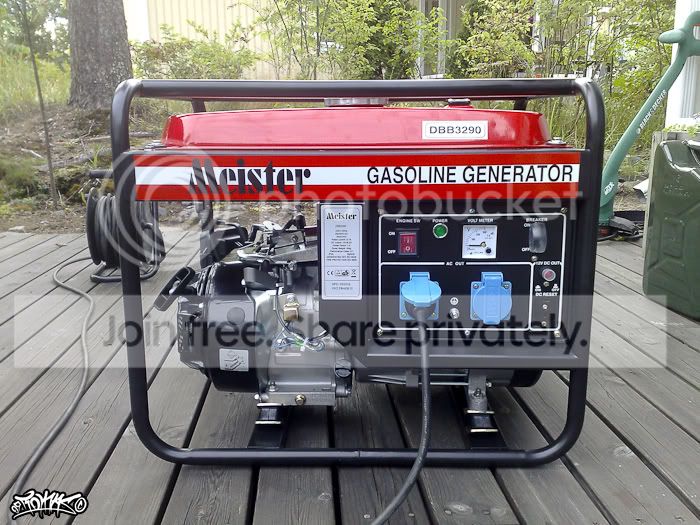
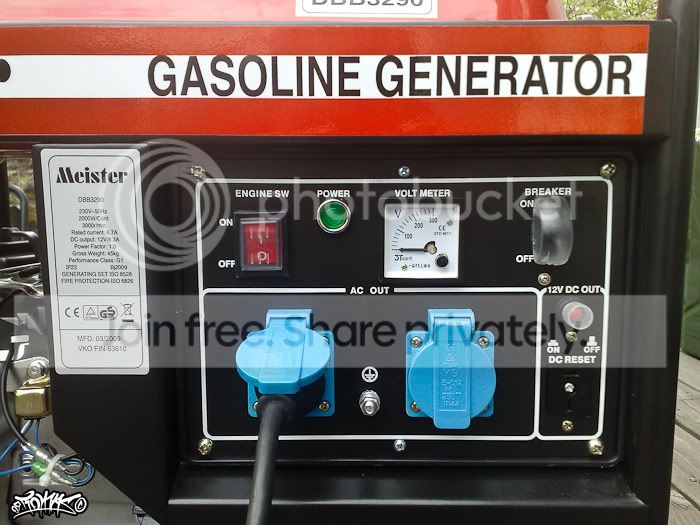
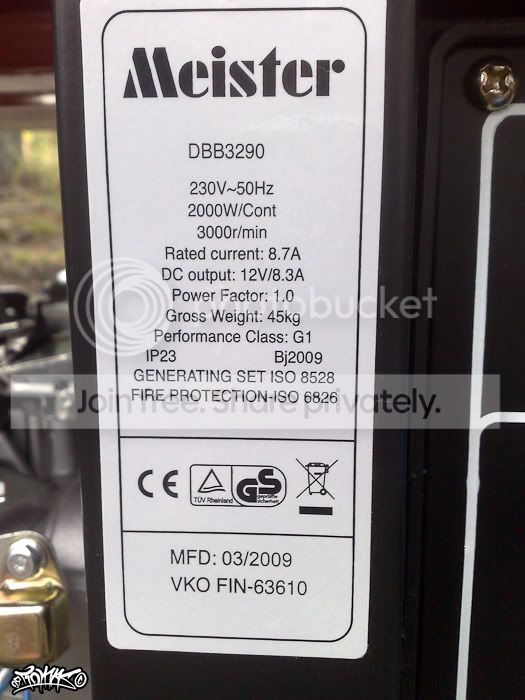
After the flashes fire, the gennie makes a short 'catch up' kinda noise, but I'm told that's quite normal.

[YOUTUBE]<object width="480" height="385"><param name="movie" value="http://www.youtube.com/v/XaqhPkVCCm0&hl=en&fs=1&rel=0"></param><param name="allowFullScreen" value="true"></param><param name="allowscriptaccess" value="always"></param><embed src="http://www.youtube.com/v/XaqhPkVCCm0&hl=en&fs=1&rel=0" type="application/x-shockwave-flash" allowscriptaccess="always" allowfullscreen="true" width="480" height="385"></embed></object>[/YOUTUBE]

Due to the frame rate of the vid, it looks as if the flashes aren't firing but they are. All is as it should be in that department.

Before I hear the 'that's SO loud' comments, I know it's not quiet at CLOSE proximity but on an actual shoot Mike the Meister will be be at least 20 meters or more away from the set where talking volume is not affected :lol: ;)
 
Here's some nasty N95 pics too

28082009109.jpg


28082009105.jpg


28082009107.jpg


All seems well really, I tested this out for around an hour and a half and even gave it harsh going over in terms of heavy repeated flashes, the recycle times were precisely the same as using a conventional AC outlet too.

Bare in mind, I can run studio lights all day on less than 30 euros of gas. Battery packs, with any brand of lighting, will need recharging a few times in a day. Considering the price difference, which is enormous, I'm pretty pleased so far.

My ideal set up will be either a 600ws or 1000ws main light and 2 400ws side/rim lights for starters. Modifiers ranging from a 170cm octabox (arrives monday) and two 120cm softboxes when the funds allow.

Rest assured, if anything does explode, I'll let you know, but I assume that would have happened already.
 
Has anyone mentioned possible power drop if you are using long cables at high current? Might be worthwhile a quick test at length. Also, be wary of your cables getting warm (although I think you said the lakes will be frozen)
 
Has anyone mentioned possible power drop if you are using long cables at high current? Might be worthwhile a quick test at length. Also, be wary of your cables getting warm (although I think you said the lakes will be frozen)

No, they haven't mentioned it but it's something that I am vaguely aware of. Cheers for bringing it up :thumbs:

Although, isn't this why the more industrial strength cables are much more expensive then conventional power cables? Do they compensate for longer lengths?

So far we've tested 40 mtrs, I do plan on having a 50 mtr for each AC outlet though.
 
There will always be a voltage drop. The industrial cables are either going to be better shielded (in case of being damaged) or better able to withstand the build-up in heat. Make sure that you do not have a cable coiled, and try to separate any cables by a short distance, (inch) if you are running them in parallel.
 
There will always be a voltage drop. The industrial cables are either going to be better shielded (in case of being damaged) or better able to withstand the build-up in heat. Make sure that you do not have a cable coiled, and try to separate any cables by a short distance, (inch) if you are running them in parallel.

Your a gem! Very appreciated mate.

Is there any math one can apply for cable and voltage drop off?
 
Back
Top