

Calculating aperture / flash power off camera

Marcus Geezer

Suspended / Banned
Messages
3,522
Name
Marcus
Edit My Images
Yes
I am on my learning curve regarding off camera flash and am starting off with one speedlite on a stand. No background. Almost unwilling but bribed subject (my 2 yr old son). I'm using the Rf-602 setup and want to do it all manually as i want to learn all about how this works from the ground up, so camera is on manual as well.

I'm happy with shutter speed / aperture relationships regarding flash vs ambient light and just have hopefully a basic question regarding calculating what aperture to use.

I think the calculation is EV / distance in metre = F stop for ISO100

So if I am using a speedlite 580EX II with EV=58, no diffuser or softbox, flash pointed at subject, camera at ISO100 shutter 1/125, subject 2 metres away from flash. Very simple setup, with the flash 45 degrees to my right.

58 / 2 = 29 (Settled on F22 as a starter).

Tried that, too dark. The beauty of digital photography is that I can review and adjust using the histrogram but bit cheesed off I couldnt calculate so added a stofen diffuser and ended up with this.
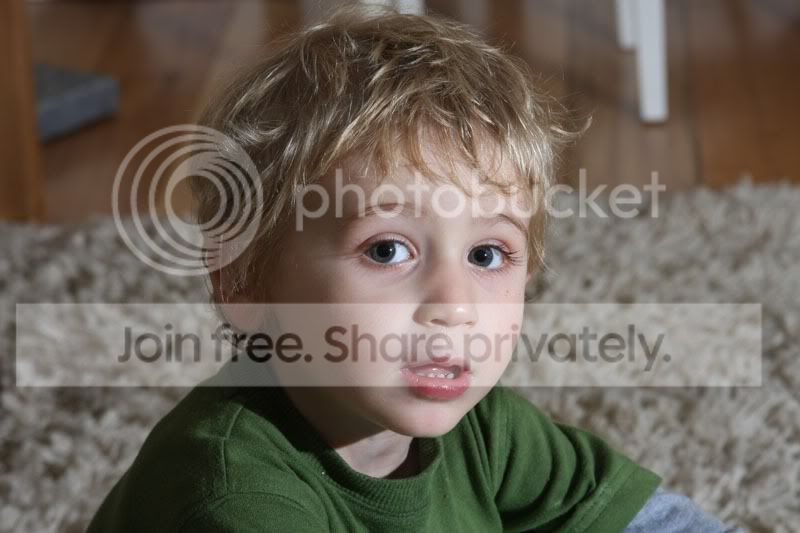
2009_11_23_3941s.jpg

(I know not an outstanding photo but just trying to get lighting correct.)

ISO100
Shutter 1/125
F8

What am I doing wrong?

Admittedly I can just use my histrogram to adjust, and equally as I build experience I'll just know roughly where to start from, but being an engineer I'd like to be able to know before I've even switched my kit on through calculation that my starting point is about right. Also if using a stofen diffuser or a softbox, what factors should I use to compensate?

Any help, tips, hints, very muchly appreciated.
 
What power did you have the flash on? At 2M on full power you would be lucky not to blind your subject! certainly your camera won't record much of it at f22.

Shutter=ambient
Aperture=flash exposure

You have shot it with a tiny, weeny hole in the lens (aperture) which has not let in much light.

The guide number is "The 580EX's maximum guide number is 58 (105mm, ISO 100 in meters) " So that's where the 58M comes from.

I think your "problem" is being caused by simply not allowing enough light into the camera.

As an engineer you may want to learn about inverse square law which does not figure in your formula above.

Inverse square law is best described as the rate of fall off of light and it is not a linear relationship but rather a square law. The basic to remember is that for double the distance you don't half the amount of light hitting a subject but divide it by four.

You are quite right in that your shutter controls the ambient but it's your aperture that controls your flash exposure and it's quite normal to have a bit of mucking about at setup. As you get more experienced you will be better able to guess the required settings but certainly outdoors they vary dramatically with the balance required for each shot between ambient and flash.

Indoors I have seen people with a bit of string on a flash stand so they know exactly the subject distance required for a particular setting.

Hope that helps.
 
Thanks Ali,

Full power! Hmmm it was a bit bright and made the dog run for cover as he wasnt happy! son thought it was funny and kept shouting 'again!' again!' I suppose for indoor shots where I'm not competing with high ambient I should start off with prob about half power and go from there?

I'm familiar with inverse sqaure law but being an electrical engineer dont really need to use this everyday, but was figuring that the basic EV/distance = F stop took that into account? At F22 I agree not enough light was being let in, hence ending up with F8 (with diffuser).

Just a bit frustrated that I cant calculate what I need to use.
 
Delving VERY deep in my VERY dim and distant memory.....is that not the equation we used to use in the good old days of film, in which case you might have to divide by the distance in feet rather than meters?
 
I think the calculation is EV / distance in metre = F stop for ISO100
Aren't you getting confused between EV (Exposure value) and Guide Number?

Every flashgun has a guide no which is an indication of it's power output. You can use the guide number in two ways...

(1) Divide the aperture you wish to use into the guide number to ascertain the camera to subject distance.

(2) Divide the camera to subject distance into the guide no to ascertain the correct aperture.

EV (exposure value) is a completely different thing,
 
Aperture equals guide number divided by distance. Distance must obviously be in the same units as the guide number is given in. The guide number is also given for a set film speed - usually ISO 100. If you are using anything else, then the aperture must be changed to compensate.


Steve.
 
Ok a 580EX II has the following.

Guide Number 190 (at ISO 100, feet) / 58 (meters)

They quote the guide number as being 190 feet or 58 meters, and an EV of 58. EV and guide number seems to be the same thing.

So this aside, how do I succesfully use this?

Lets assume flash at full power 3 metres from subject ISO100.

58 / 3 metre = 19.33

or

190 / 9' 10" feet (approx) = 19.38

Same answer. Which didnt work. If this should work I'll try again and see if I was doing something else wrong?

If however I am using the flash on half power to save blinding my subject is the following then applicable?

58/2 = 29

29 / 3 metre = 9.66
 
EV is exposure value. It is a combination of shutter speed and aperture and has nothing to do with amount of light so I'm not sure where that reference comes from.

If you are using the flash on half power then you need to open up by one stop or divide the guide number by 1.414 (square root of 2) which will give you the same figure.

So to use your figures: 58/1.414 = 41.2 Aperture = 41.2/3 = f 13.6

Nearest full stop to your 19.38 figure is f22, nearest full stop to my 13.6 figure is f16 - one stop different as predicted.


Steve.
 
Thanks Steve. I'm itching to give this another go so I'll see if the hound is feeling photogenic in a bit. Maybe with the flash at half power instead of full power he wont try and hide behind the couch again.
 
I'd have to say I think you're making hard work of it Marcus, Flash was never an exact science anyway, and a bit of fine adjustment and tweaking was usually required in the film days - but you had to wait till you got your prints back to find out. That's why Polaroid backs were so popular with studio photographers.

Nowadays you have your preview screen and instant playback. If your first shot was in the ball park but a little dark then the easiest answer is to nudge your flash a little closer to the subject until you're happy with the result. ;)
 
I have to admit that most of my off-camera flash goes in the order of:

Set the exposure I want for the ambient light.
Set the flash on half power. (or even quarter power if it's close to the subject)
Take a shot.
Do some 'chimping' on the viewfinder.
Adjust flash power until I get the desired effect.

If the flash power can't get there (can't get it high or low enough) then adjust my aperture to suit and compensate the shutter speed to continue to correctly expose the ambient.

It's a little trial-and-error but you get a feel for what settings to start with and it's not a long process from there.
 
The 580EXII has a guide No of 58
 
I would like to thank everyone for their input. I've just had a play and mutley was feeling extemely shy and photo's of his backside sticking out from behind the couch arent good looking, even if the histogram says otherwise! But... I seem now to be able to setup the flash and camera both in manual and with just a couple of goes get a pic which seems to be about the correct exposure.

I was hoping that to a certain extent you could use calculation to get nearly there and then a bit of chimping on the histrogram to get it exactly right, but it seems as the much appreciated comments suggest experience seems to be the way forward to knowing where to start from.

I'll make a note of your workflow incapete and use that.

Lesson 1, 'learnt'. :thinking:
 
I know, it was a mistake, I hit the enter key too soon.

I was going to say

The 580EXII has a guide number of 58 and the 430EXII has a guide number of 43 just for future reference but it all seems a bit lost now.

This is a good watch if you are using Canon gear.

http://cpn.canon-europe.com/content/masterclass/canon_flash.do
 
I would also use the term Guide Number, but I think we're talking about the same thing, and that you're on the right lines.

The Guide Number is only a guide though, and is estimated according to the parameters you've quoted, but also takes in to account an 'average room' (that is never specified) which can make a big difference, eg shoot outside and you'll need more light than indicated, shoot in a small light room like kids in the bath and you'll get at least two stops more light than outside.

Guide number is quoted for full power at 105mm zoom. If the flash is set at 50mm you'll be two stops* down on that (inverse square law) and every time you reduce the power from say 1/2 to 1/4 to 1/8th etc that is one f/stop shift each time.

Calulating flash exposures fully manually is notoriously difficult even when you know all the variables and have a lot of experience but give it a go using the information you have now and you shouldn't be a million miles out with your calculations. If you get within a stop of optimum, bearing in mind manufacturers generally lie about their Guide Numbers anyway, that's a result :thumbs:

Guide numbers only work for direct flash. If you fit a Stofen, or bounce it, you're into a whole new nightmare ballgame which is virtually impossible to calculate with any degree of accuracy as the bounce surface and its distance is the main contributing factor.

I agree it's good to learn and understand, but when you've done that, connect the flash to the camera with an E-TTL cord and say a small prayer of thanks.

Edit: in practise it's not actually two stops, because I've just tried it with a flash meter. More like one stop as a very rough guide. That's because, while the ISL theory says two stops, the nature of the flash gun's reflector means it's very poor at projecting a perfectly rectangular beam that fits the coverage of the lens exactly. In fact it's rather more a much larger oval pool and zooming the head just concentrates more of the light in the middle. The result is that you don't lose as much light as the strict application of the inverse square law suggests. However, the general principle is the same and as you zoom back so the light is spread over a wider area, which means the average intensity is reduced.
 
The easiest why of working out the settings to have if you do not have a flash meter is to take a photo and look at the histogram and if it is not to the right then open up until you get it over to the right.
so easy now unlike film days when Polaroid’s were used
 
I agree it's good to learn and understand, but when you've done that, connect the flash to the camera with an E-TTL cord and say a small prayer of thanks.

and give up most of the creativity on offer too :p lol
 
and give up most of the creativity on offer too :p lol

Not unless incorrect exposure is part of the creative brief :D
 
ttl is usually ball park right, just a bit dull :D

What is dull about four flash guns, in any remote position you like, firing automatically at any power output selected, all controlled from the camera position?

I would tend to say not dull at all, and a lot easier than fiddling about setting and checking everything manually, re-setting and re-checking until it's right. Then you have to do it all again if the subject moves :thinking:
 
:)


EDIT: To be honest in the long run I'll prob be going TTL, however I want to learn the hard way so that if TTL isnt coming up with the goods at a shoot I've got the knowledge and experience to go full manual and still provide what I'm after. I've learnt a lot from this thread.
 
:popcorn:


EDIT: To be honest in the long run I'll prob be going TTL, however I want to learn the hard way so that if TTL isnt coming up with the goods at a shoot I've got the knowledge and experience to go full manual and still provide what I'm after. I've learnt a lot from this thread.

I love ETTL -having done weddings years ago with manual flash it's an absulute godsend. I do think though that getting your head around manual flash will give you a better overall understanding in the long term. :thumbs:
 
Back
Top