Buses - uneconomic services

lindsay

Admin
Messages
8,060
Name
Lindsay
Edit My Images
Yes
Recently there has been a spate of news stories about bus companies cutting services for various reasons. Now I never use buses (that time may come eventually), but I notice that most services in my location are fulfilled using double decker or at least long single decker buses, all diesel-engined, but I have never seen more than about 8 people on any of them - this includes intra-town as well as cross country inter-town routes.
Surely it would save a lot in fuel, maintenance, capital costs and depot space, if most services were run using 16-22 seaters max? I think even drivers might need a lower qualification. Am I being naive?
 
I saw this questioned on another forum I frequent a couple of years back and the summary was that the driver was the costliest overhead, and that savings in purchase and maintenance costs were made through standardisation that generally offset the fuel costs.

Round here we still seem to seeing corporate sulking at the removal of all subsidies from the bus companies a couple of years back as the county council tightened its belt.
 
"big" buses give the operator more scope. Running the "hopper" buses mean that is all you can use them for (which is why around here they are run by a separate company)
 
All I know is that there are a lot of pensioners who have had their independance curtailed by penny pinching/route cutting. My own mum could get on the bus within 50 metres of her door, pop to the library/social club or shops and back without a worry. The more that she sits, on her own, the less mobile she becomes and the more lonely! "You're the first person that I have seen all week!"
 
Am lucky here in North wales that we still have a decent service, we almost always use the bus to go into town , it’s not worth messing about trying to park and also have the option that we can both have a pint at lunchtime too :)
dont very often see the bus empty either
 
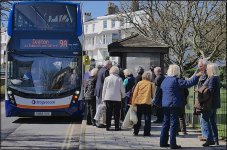
Here, in south east Devon, the buses are quite busy most of the time, with the double deckers more than half full on most days at most times. Mornings and late afternoon they're typically 90 - 100% full.

It seems that we're pretty lucky...

9A bus arriving at The Triangle Sidmouth GM5 P1220562.jpg
 
We had a bus service that ran to a couple of local towns 4 times a day when we first moved to our village 2 years ago. That’s recently been cut in the latest round of council budgets. There’s now only one bus that stops here, but it only takes kids to school in the morning and back in the afternoon. Anyone can get on it but it literally has two stops, so it’s very limited.

Luckily there’s a very useful Good Neighbour scheme where car owners will give lifts to people without transport, otherwise older villagers would be completely stuck.
 
They're a nightmare for wheelchair users:

1. Women (mainly) like to nick the disabled space for their kids' buggy or pram and it often results in a row with them or the driver if you try to get them to fold it up and/or move it.
2. There is only one wheelchair space on each bus, so if it's occupied by another 'raspberry' when you're waiting at the bus stop - tough luck. You have to wait an hour or longer for the next bus and hope there's not someone using the space on that one.
3. Grumpy drivers don't like getting off their arse to put the ramp down and are only occasionally polite or helpful.
4. You're rear facing, so you have to put up with looking at all the other miserable plebs who don't want to be there either.
 
Last edited:
If local councils didn’t have to contribute so much for free bus passes they would have more for subsidies.
Crazy that people have a free bus pass, but no buses to use them on.
 
I remember they cut a load of buses round here a few months after the free bus passes came in because the revenue they got from the council for “free” travel was only half that they were getting from the senior rate fares before that.
 
Here, in south east Devon, the buses are quite busy most of the time, with the double deckers more than half full on most days at most times. Mornings and late afternoon they're typically 90 - 100% full.

A great reason why double deckers are run through the day.

A 100% full double decker means you need a double decker. Or you need two buses and drivers to provide the same service..

If you have a fleet of double deckers because you need them (see above...) then to run single decker buses during the day you also need a fleet of single decker buses. And if you want to go down to a hopper bus size, then you also need a fleet of them too.


c.f. people saying "I live at the end of the route and there's hardly any people on the buses there". Well, yes, that's because it is at the end of the route... :ROFLMAO:
 
Last edited:
I rarely travel on local a bus though I have a bus pass. I used to use the bus before COVID because I thought it was a little more green to do so but now do not see that it's worth the risk generally so use my car. Of course, it seems a shame that the subsidies may be cut but perhaps I should not get a free pass. However, if I did not have the free pass, I definitely would not use the bus so this would not help.

Dave
 
Surely it would save a lot in fuel, maintenance, capital costs and depot space, if most services were run using 16-22 seaters max? I think even drivers might need a lower qualification. Am I being naive?
The bulk of the operating cost and the major constraint of the operators is the drivers, so no it wouldn't save much money. The driving licence category changes at over 16 seats, or over 8m length if with over 8 seats, so only a >15 seat, >8m bus can be driven on D1 and that's stuff nor much bigger than a LWB Transit which are rarely set up to accessible - it's only the larger buses that tend to be designed for step free access and have wheelchair parking.
 
I think that may be the biggest issue, the lack of step-free, wheelchair friendly accommodation and entry, in smaller vehicles. I still think it is a bad idea to be driving these huge vehicles around inefficiently though. It needs some innovation from someone in the industry to design and produce efficient, smaller vehicles with appropriate accessibility features, with an operating mode that makes it economically viable. Or subsidise buses to a similar extent that trains are, but in public ownership.
 
I like the idea they use in turkey the dolmus smallish mini buses , that do a shorter regular run for a fixed charge . but obviously our rules and H&S wouldn't allow a system that worked to the benefit of all . they would rather run one big 75 seater every 2 hours than four 25 seaters every 15 minutes
 
It needs some innovation from someone in the industry to design and produce efficient, smaller vehicles with appropriate accessibility features...
There was a programme about this on TV a few years ago.

Examples from various countries were shown, including a small bus with a rear panel that dropped to make a ramp, like a back to front landing craft. According to some interviewees, various British operators had a problem with the operating costs, saying that a driver serving 50-60 passengers is a lot cheaper than one who can only serve 10. Thatcher's obsession for private enterprise has served very few Britons well since 1980! :(
 
I know the main bus that run through our village runs every 10 mins as it the one that goes from Preston to Bolton, during the day it's pretty empty (apart from market day in the next town) but in the morning and evening rush hours is full. It's not economic for the company to have two sets of buses with the large double deckers just sat in the garage all day and only uses at rush hour.
 
Back
Top