burst mode with flashgun?

realspeed

Suspended / Banned
Messages
8,827
Name
Bazza
Edit My Images
No
This question came up on another site, Can you do **burst photos** (one quickly after the other) with a flash gun.
several replies said no which may be correct if not using the right equipment. So me being me had to try.
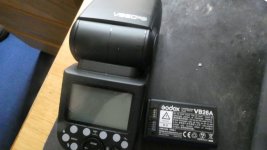
Camera Panasonic G9ii and Godox V860 flash gun with remot trigger just so I could Hand hold to video.
View: https://www.youtube.com/watch?v=_o4G8qOXRmM

First thing I came up against was sync the flash with the shutter which has to be in mechanical mode. so the Godox in single flash mode after trying something else looks to be the answer.
 
Last edited:
I’ve done it with my Godox V1, problem is that you haven got to do it too many times before the flash puts itself in some sort of limp mode and limits the rate - and the higher power the quicker it comes - but yes- can be definitely be done!
 
Mark

the Godox V860 has this large battery which is suitable for your godox as well . could be down to just a different flash gun
vvv.JPG
 
Last edited:
It doesn't really have that much to do with the size of the battery. It's all down to your shutter speed and how fast the flash can charge.

If you are firing off frames at a faster rate than the flash can recharge then the power will get progressively weaker as you go. Obviously the more power you set on the flash the longer it takes to charge, the quicker you will see this effect.
 
Last edited:
Interesting and thanks for your replies. This is something i had not even considered before , that is burst with flash
 
When I had my lumix kit (g9 and S5/S5ii and S1) this was always an issue as it wouldn’t fire bursts with focus bracketing either.

Don’t seem to have that issue with the Olympus stuff can fire off flash with electronic shutter (I learned this yesterday) and the focus bracketing.

Some forums I read at the time suggested it was to do with a communication issue between godox and lumix systems, and that lumix hadn’t amended it in the firmware (or something).
 
Last edited:
With the pana G9ii flash doesn't work in electronic shutter mode only with mechanical shutter
 
Mark

the Godox V860 has this large battery which is suitable for your godox as well . could be down to just a different flash gun
View attachment 457296

It’s actually the thermal protection mode - apparently the v1 is quite sensitive and enters the mode fairly eagerly - that would be my experience - and you don’t notice in normal use, but as soon as you fire a few rapid bursts at 1/8 or higher the dreaded icon appears in the display
 
The best way to do it is to use a flash gun that uses 4 x AA batteries with a booster pack like a Godox PB960.

So a flash unit like a Godox TT685II. Lion units like the V1 and V8960 don't recycle fast enough.

The AAs power the operating system & the external unit powers the flash (roughly speaking).

Bump the ISO and run the flash at 1/4-1/8th power or less.

Or use a strobe like an AD200/400/600.

That's the way that press packs have worked for decades.
 
As already said, shutter speed to the fastest sync speed, then flash in low power 1/16 or whatever, depending on the flash you should get a short burst off before the flash runs out of power and has to recycle. I often do this with the confetti shots at weddings, I'll get maybe 10 flashes or so before the flash pauses.
 
Depends on the flash to subject distance and aperture, and flash power.

simple use of the physics involved.

A mediocre speedlight shooting insects at 6 inches easy

An AD 200 shooting f5.6 at 6ft from the subject should be easy.

Now try a mediocre speedlight 6ft from the subject at f16. You’ll get 1 shot per 4 secs or similar.

Inverse square law, subject to flash distance and aperture will dictate required flash power for each shot.

Obviously if the flash power required is about 1/16 of the capability of the flashgun, the flash will fire several shots per second until the batteries run out. If the flash power required for your shot is full power, you’ll get 1 shot every 2-5 secs depending on your recycle time.

Ought to be obvious and I’m puzzled that it’s not.
 
It’s a simple experiment for anyone
Shutter speed of 1/125, attach flashgun, set continuous shooting and Manual power on lowest setting and hold the shutter button.
You’ll get dozens or hundreds of shots depending on what the min power is, the capacitor size and battery performance.

Then change only the power setting on the flash to full power and you’ll get 1 flash every second, 2 secs or maybe as much as 5 secs.

And we all know that the Inverse square law decides how much flash power we need dependant on aperture and flash distance. Small distance = little power, large distance = more power.
 
It’s a simple experiment for anyone
Shutter speed of 1/125, attach flashgun, set continuous shooting and Manual power on lowest setting and hold the shutter button.
You’ll get dozens or hundreds of shots depending on what the min power is, the capacitor size and battery performance.

Then change only the power setting on the flash to full power and you’ll get 1 flash every second, 2 secs or maybe as much as 5 secs.

And we all know that the Inverse square law decides how much flash power we need dependant on aperture and flash distance. Small distance = little power, large distance = more power.
Some very valid points, but a very big factor (and related to capacitor size) is the technology, which is IGBT. Regardless of the power setting, the flash always fires at full power but, as an example, if we set the flash to 1/128th power it only fires for 1/128th of the time of a flash discharge at full power.
What this means, in practice, is that there are at least 127 more shots in the capacitor before it's empty. That's an over-simplification because if, for example, we are shooting at 10 frames a second it will take 12.7 seconds to use up all of the capacitor storage, by which time it will have fully recharged itself about 3 times, so if the camera buffer can keep up and if the flash doesn't run too hot, then in theory we can just keep going:)
 
Some very valid points, but a very big factor (and related to capacitor size) is the technology, which is IGBT. Regardless of the power setting, the flash always fires at full power but, as an example, if we set the flash to 1/128th power it only fires for 1/128th of the time of a flash discharge at full power.
What this means, in practice, is that there are at least 127 more shots in the capacitor before it's empty. That's an over-simplification because if, for example, we are shooting at 10 frames a second it will take 12.7 seconds to use up all of the capacitor storage, by which time it will have fully recharged itself about 3 times, so if the camera buffer can keep up and if the flash doesn't run too hot, then in theory we can just keep going:)
Absolutely

I think we need to add…
If we’re using half power, after a shot there’s only one other shot in the capacitor, and if the capacitor takes 5 secs to recharge that means we only get a burst of 2, then one every couple of secs or so as the capacitor charges
 
Back
Top