Beginner Best budget lens for clear action shots

Kateloucook

Suspended / Banned
Messages
6
Edit My Images
Yes
Hello all

I'm a relative beginner in the world of dSLR photography. I do try and take images on manual mode and have taken a few walking courses around London but am always striving for that crystal clear image.

Myself and my husband recently got a lovely chocolate Labrador and I love nothing more than taking the camera on walks and taking photographs of him running, jumping, swimming etc. However, I have yet to master that perfect shot of him mid jump or mid ball catching which shows every hair on his coat, perfectly clear with a beautiful depth of field and blurred background.

I believe the issue is not having the right lens so I wanted to ask what people would recommend. I have a Canon 600D and my preferred budget would be under £500. I'm happy to get non canon lenses as have used Sigma before without issue.

My two lenses I take currently are:
-canon EF 50mm f/1.8 II. I love love this lens and the DOF it creates but I find with Monty (the dog) moving, I rarely catch a clear photo
-canon EF-S 10-22mm f3.5-4.5 USM. Again, this is a beautiful lens but great at landscape, not so good at focusing on the subject.

Any lens recommendation or guidance that I've got the right kit and I just need to adjust my settings would be great.
Thanks
Kate
 
A used Canon 70-200 F4L would set you back around £350 and is a fantastic lens.
Very light and very quick and accurate focusing, ideal for fast-moving pooches.
It won't give you that really shallow DOF that the F2.8 version would but still gives a nicely OOF background, especially towards the longer end.
Other than that you may be able to pick up a used Sigma 70-200 f2.8 within your budget.
 
As well as kit it sounds a little like technique could be a factor here too, as is understanding what might be possible.

Do you have any examples of A) shots from other people like you want to achieve and B) shots you have taken but aren't happy with, including what settings you use.
 
Last edited:
agree about the F4 L lens, had a one of those and its brilliant for the price, really fast autofocus which is much better than the Canon 70-300 USM, not to heavy but really good build quality and should fit nicely with the 600D.
 
The 70-200/4 is a great option but the 85/1.8 might work for you too. It's a good lens, will give you a bit of distance from your lab and potentially more background blur than the long zoom. I can't remember who fast mine focused which suggests it was quick enough. I remember paying £180 for mine used from ffordes as it had a slight mark on the front which didn't bother me. Not sure how much they are now.
 
Last edited:
Heloo Kateloucook and welcome to TP.

As Ned has said posting a couple of your images that you are not happy with would help other to suggest a solution.

You said you try to photos on manual mode. Manual mode has its place but it not the holy grail of photography. Manual will not necessarily give you the result you want. As your dog is a fast moving subject shutter priority is probably a better option, but seeing you current shots would help.

Dave
 
Thanks so much for your replies! I'm now going to start looking at the lenses you suggest! I am a slave to manual and perhaps I need to understand shutter priority a bit more as from memory on my beginners course, this might be the best mode to click in!

I can't add more than one photo so I'm going to post a few replies.

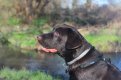
Below is a photo I like: I love the DOF and blue/green colours of the park behind him. I like that you can see his fur clearly and eyes.
It's f/4.5 1/200 shutter and ISO100 (using 50 mm lens)
Monty example 1.jpg
 
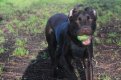
This is typical Monty, bounding towards me with a ball. I tried to use the cross hairs to get him but no chance:

F/5 1/320 Shutter ISO200 (I realise the shutter should have been faster but then I had to use higher ISO which I always thought you shouldn't do!)
Monty Example Blurry.jpg
 
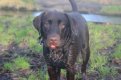
I love this photo for so many reasons (this is pre editing where I sorted the washy colour). I love his expression, the background etc but it's just not quite clear in his whole face. Parts of it are clear but others are a little blurry

f/4.5 1/200 shutter ISO400

Monty Example Tongue.jpg
 
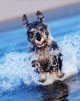
How? For the last shot a high shutter speed (probably somewhere upwards of 1/1000, achieved by good light in this case or you would up the ISO), a telephoto lens to narrow the background so it's less busy, shooting from a low position to be on the eyeline of the dog which also puts the background further behind it and gives depth to the shot and continuous AF to make sure the dog is in focus.

Compare that to Monty bounding towards you, the shutter speed is slow, it isn't very telephoto so the background is wider, you have shot from a bit higher and he is close to you so the background is close and relatively in focus and it looks as though you weren't using continuous AF as Monty as already run through the point of focus.

Being a slave to manual mode is a bit of a fools errand, it's a tool for a job just like all the semi-auto modes and you shouldn't be scared of upping the ISO because it is better to have a slightly grainy shot than a blurry one. Besides, ISO on modern cameras is good enough that I would happily shoot at ISO1600 without even thinking about it.

With both of the photo's you like the photographer has a good grip of the basics and, that taken for granted, has concentrated on the background and framing of the shot as much as anything else - subject, background, light. (or often, light, background, subject - as it should be here as you already know the subject).

So, in short, you want the 70-200mm lens to narrow the background yet keep the dog in focus and lots of practice :)
 
Last edited:
Please don't take other photographers' work, download it and then post it here. That's called copyright infongement.

If you want to reference an image, link to it.

As for how to improve, Ned is spot on.
 
I'd put the camera in shutter priority and let the camera short the rest out. In the camera menu set a maximum iso that you're happy to use, then select auto iso.
 
(I realise the shutter should have been faster but then I had to use higher ISO which I always thought you shouldn't do!)
The balance to find is between blur from movement and noise from high ISO. I'd rather have a sharp shot with a bit of noise than a blurry shot with no noise. Your mileage may vary :)

Edit: Oops, just seen that Nawty has already given you better advice a few posts above.
 
Last edited:
Stick your 50mm f1.8 on and get shooting!

This is a typical one taken with a 7d and 85mm f1.8 at shutter of 1/1000 and f2.2. As mentioned get down low, normally lying down and focus on the head on continuous and shoot away. image.jpg
 
Last edited:
This one really shows that getting down low really makes the photos so much better and helps to blur away the background as well. Very similar settings to the one above.

image.jpg
 
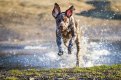
LOVE the clarity of this action shot...how!??
View attachment 60162
Just like previous similar threads, you need to learn to 'read' photographs, to find what's making it work.

This one starts with a bright contrasty day, which gives a great light to the image but also helps the camera to focus.

So skill no1 is 'learn to 'see the light', it sounds like a cliche but talk to serious photographers and they can bore for hours about the subtle nuances of light falling on a subject.

Skill no2 is viewpoint, all those great action shots of dogs are shot down at dog level

No3 is choosing a location that'll add to rather than detract from the subject.

Notice we've covered most of the important stuff and haven't started on gear or settings yet?

No4, continuous focus mode, and keep practicing tracking moving subjects. There are many techniques that might help but expect a low keeper rate*

No5, as above the 70-200 f4 is a great lens for the money, the IS version costs slightly more but may be worth it for you.


* beginners have rubbish keeper rates and believe when they get better all their shots will be 'keepers'. It's not true! The only difference is that my 'rubbish' is generally in focus and well exposed. It's still not as good as the better shots though.
 
I went to a talk at my camera club a few weeks ago, the guest speaker was Dr Michael Leach. He's a professional wildlife photographer and has worked for the BBC, National Geographic etc. During his talk and display of photos, he mentioned his keeper rate, on his last expedition called Pole to pole, his keeper rate out of 15,000 was about 190. This wasn't to do with shots being out of focus or over/under exposed, but because they weren't original. It was all about getting a different perspective or something unusual.
 
Best advice I would give is to put a little more distance between yourself and your dog. You dog is pretty close, especially given the range of the lenses you mentioned you owned, and you're probably hitting minimum focus distance for your lens (it will not focus on things that are really close to it).
 
... the 70-200 f4 is a great lens for the money, the IS version costs slightly more but may be worth it for you.
Actually the IS version costs nearly twice as much: £795 vs £439 new. The non-IS version is arguably the best bargain in Canon's entire line-up.

In the current situation I would question whether IS is useful. We're talking about shutter speeds around 1/1,000th for action shots, and IS doesn't add anything. Sure, it has its uses - static subjects in poor light - but not here.

I'd also question the extent to which a zoom is necessary or even desirable here. When you're after action shots of the dog you have control over where you are and where the dog is, so using a prime lens and choosing your position to suit the focus length is quite feasible. That's where lenses like the 85mm f/1.8 come in. It's roughly half the price of the 70-200mm f/4 (£236 new) and it forces you to think about the relationship between the subject and the camera, which is a good thing if you're a beginner. Zooms can easily make you lazy.
 
Actually the IS version costs nearly twice as much: £795 vs £439 new. The non-IS version is arguably the best bargain in Canon's entire line-up.

In the current situation I would question whether IS is useful. We're talking about shutter speeds around 1/1,000th for action shots, and IS doesn't add anything. Sure, it has its uses - static subjects in poor light - but not here.

I'd also question the extent to which a zoom is necessary or even desirable here. When you're after action shots of the dog you have control over where you are and where the dog is, so using a prime lens and choosing your position to suit the focus length is quite feasible. That's where lenses like the 85mm f/1.8 come in. It's roughly half the price of the 70-200mm f/4 (£236 new) and it forces you to think about the relationship between the subject and the camera, which is a good thing if you're a beginner. Zooms can easily make you lazy.
I was thinking 2nd hand where the difference would be less, I only own 1 IS lens but I know they can be useful for many.

A zoom will give more chances of getting the shot of a target coming towards camera.

Even with a fast camera, a dog running towards the camera might give you 2 suitable frames, whereas zooming with a motor drive will give a lot more than that.
 
best upgrade i made with my old 550d was a canon 70-200is f4. also use a1 servo for moving shots and keep the shutter speed up high 1600 or more to freeze motion
 
Back
Top