Beginner to film - what film?

Lefrash

Suspended / Banned
Messages
136
Name
Fraser
Edit My Images
Yes
Firstly, apologies if I've posted in the wrong forum... it was a toss up between Talk Film or Beginners; I thought this might be more a niche thing so went for here.

I'v recently acquired my dads old camera from his youth. It's an Agfa Silette, and I've got a hold of the manual too, so I've got a good idea of what's going on with the actual camera. As suggested by someone one here, I want to have a go at actually using it - even just for a roll or two. I'm not from a film background( i know nothing) so i need some advice as to what film to purchase. The specific rolls which are named in the manual seem to be pretty expensive, although I suspect I don't need to use Agfa own branded film.

I've seen on a different forum that someone used Kodak Tmax 400 on a similar (although not identical) camera, so I would guess this would be a good starting point. Id appreciate some other options if anyone can be bothered to enlighten me!

I hope to capture a photo or two of my mum and dad in their garden, and then maybe a few other family things outdoors - to give an idea of what I want from it.

Oh aye, another point is that I don't even know if it works so I'd rather not sink too much money in at first until i know it works!

Cheers in advance
Fraser
 
Last edited:
Hi Fraser and welcome to the best bit of TP and also yes this is the correct place.
Are you thinking that black and white is the way to go? If so then I'd suggest trying some Fomapan 100 or 400, it's a nice film and not expensive for testing a camera you haven't used before. Just a suggestion, there are still a lot of films out there to choose from.
 
For a camera that you are unsure about the functionality (shutter speeds etc could be off) then to not be thoroughly disappointed by the roll you get back i would suggest something that is quite forgiving for exposure. HP5 is very forgiving if you want black and white (labs tend to charge more for development of black and white) or Portra 400 if you want colour. The extra cost of a roll of Portra is offset by the generally cheaper developing cost.
 
You don't need to worry about matching the film with the brand of camera. Agfa film sold today won't have much to do with what was available when your camera was new, and even at the time they would just have been recommending their own products for obvious commercial reasons.

Tmax is a perfectly good choice for B&W - it's one of the more modern films with relatively fine grain, fairly similar to Ilford Delta. If you want a grainer high contrast look you might prefer Ilford HP5 or Kodak Tri-X. These are all traditional B&W films that need to be developed appropriately.

There are also 'chromogenic' B&W films like Ilford XP2 that can be developed in the same chemistry as colour films, which can be easier and cheaper to have done commercially (any high street lab can process them).

If you want to try colour, Fuji Superia 400 is a good general purpose choice, but Kodak Portra is probably a better option for portraits.

All of the above films are available as ISO 400, which is a good speed for most purposes. However, some of the Silette models have a limited range of shutter speeds, which can mean you risk overexposure in bright sunlight with this speed of film. If your camera only goes up to 1/125s and you are shooting outdoors in summer, ISO 100 film may be a better choice. In B&W you might use Ilford Delta 400 or FP4, or Kodak Tmax 100. In colour, Kodak Ektar 100 is very nice, with really fine grain.

XP2 has such a wide exposure latitude that, while it's nominally 400 ISO film, you can expose it as 100 ISO (or 800 ISO). This might be the safest and easiest choice if you want to shoot B&W.
 
Thanks folks. Alot of good info here.

@Andysnap Thank you. I must admit, I didn't think b/w but now I do!

@Craigus Yep, basically everything is unknown. It's not been used for probably 50 years as a camera, although I have vague memories of playing around with it, mucking about with the dials and sliders growing up in the 90's. Film which is forgiving is definitely what I'm looking for. thanks

@Retune Yep, this particular model is limited to 1/125, which feels absurd in modern times, although I'm assuming that's just a mechanical limitation in more budget cameras from this era. I've had a look at the superia 400 and kodak portra, and both seem very much a reasonable start.


Hopefully I'l get the film in the next week or so, and get cracking! I'll let you know how i get on. thanks again.
 
@Retune Yep, this particular model is limited to 1/125, which feels absurd in modern times, although I'm assuming that's just a mechanical limitation in more budget cameras from this era. I've had a look at the superia 400 and kodak portra, and both seem very much a reasonable start.
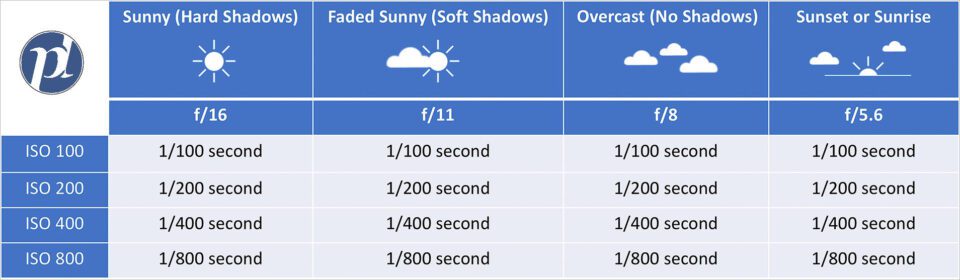
So the only issue is that, if you're lucky enough to get nice weather, full sunlight will leave you nearly 2 stops overexposed at ISO 400 if the aperture only stops down to f/16 (and you're not using an ND filter):

Sunny-16-Rule-Exposure-Chart-960x280.jpg


Colour negative film will generally tolerate this (a lot of people deliberately overexpose it a little) and so will XP2. For traditional B&W, development can be adjusted to compensate. If your lens stops down to f/22, you'll be less than a stop over, which will usually be fine. But lenses generally aren't at their best when stopped down that far.

With ISO 100, you wouldn't have this issue, but then of course you need decent light to shoot by.
 
But generally a 400 speed film will tolerate being overexposed, whereas a 100 speed film on a cloudy day will result in really wide aperture or slow shutter speeds.

So better to go for a 400 speed film. Far more flexible.
 
Or load the film when you know what the weather is like. Some of the ISO 100 films are very nice if you have enough light, and it's not as if this camera has the option of fast shutter speeds anyway. On a sunny day you'll be shooting everything at minimum aperture (though perhaps that's not such a bad thing with scale focus - I guess this isn't the rangefinder version?).
 
I ordered a portra 400 last night so hopefully be able to give it a go next weekend. I'm now beginning to appreciate the things I take for granted in my digital camera, and I've not even taken a photo yet! If things go well in my first roll then i may end up experimenting a bit more. I think 400 was the right choice to start with, although I have a feeling i would've overexposed everything without having this chat with you guys. I'll definitely be keeping that in check!

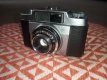
@Retune yeah this isn't a ranger finder. I'l try to attach a photo...
 

Attachments

  • IMG_20200705_181338.jpg
    IMG_20200705_181338.jpg
    131.7 KB · Views: 22
Yep, expose for the shadow and the highlights will look after themselves :-)
 
That's got a nice range of apertures, f/2.8-f/22, so even with the limited range of shutter speeds you'll be able to get a decent exposure in all normal daylight conditions. Some people rate Portra at ISO 200, making 1/125 at /f16 only a stop over in 'Sunny 16' light, and 1/125 at f/22 about right.
 
Is shooting in the f16-f22 region common in film then? I suppose it has to be if the shutter speed is a limiting factor.
 
Is shooting in the f16-f22 region common in film then? I suppose it has to be if the shutter speed is a limiting factor.

No moreso than with digital. You'll get the same softening of the image due to diffraction as you would with a digital camera (although it might be less apparent with 35mm film - there tends to be less pixel peeping). If you shoot medium or large format, then it becomes more common (and necessary) to shoot at narrow apertures if you want a larger depth of field.
 
Is shooting in the f16-f22 region common in film then? I suppose it has to be if the shutter speed is a limiting factor.

Well I rarely use those stops...but except for special\exceptional lenses most lenses below 135mm are their sharpest about F5.6 to f8 ....well that's if you are interested in the sharpest shot. And remember no anti shake with a film camera :crying: ;)
 
Is shooting in the f16-f22 region common in film then? I suppose it has to be if the shutter speed is a limiting factor.
I mostly I use film cameras with a top speed of 1/1000 or faster, which give me 3 stops more leeway - e.g., rather than shooting at 1/125, f/22 I can use 1/1000, f/8 and get the same exposure, but the shot may appear sharper because there's less camera shake and less diffraction.
 
I mostly I use film cameras with a top speed of 1/1000 or faster, which give me 3 stops more leeway - e.g., rather than shooting at 1/125, f/22 I can use 1/1000, f/8 and get the same exposure, but the shot may appear sharper because there's less camera shake and less diffraction.

Ah! like me a sunny weather shooter ;)
 
And remember no anti shake with a film camera :crying: ;)
Yes there is, with the Canon EOS 35mm SLR camera system! :)

The world's first interchangeable 35mm SLR lens with built-in Image Stabilisation (anti-shake) was the Canon EF 75-300 IS, which was launched 25 years ago in 1995. By the late 90s other Canon EF IS lenses had joined the fold, including the EF 28-135 IS, which is a lens I still use regularly on my 35mm EOS film cameras.

According to Canon, all Canon EF lenses (including IS and L versions) are compatible with every EOS camera ever produced (reference: https://www.canon.co.uk/lenses/tech-guide/compatibility/ ). I believe this claim only applies to genuine Canon made EF lenses though, so if considering an EF fit lens made by another manufacturer it may not have the same forward/backward/future compatibility, so buyer beware!

So yes, there is anti shake with Canon EOS film cameras. It's in the Canon EF IS lens, not in the camera, but it does the same job! (y)
 
Last edited:
I think 400 was the right choice to start with, although I have a feeling i would've overexposed everything without having this chat with you guys. I'll definitely be keeping that in check!

You don't really need to worry about overexposing or being precise with exposure when using Portra 400. Check out this thread to see the crazy amount of latitude it and other colour negative films have:


You would need to seriously overexpose not to get a usable image. If in doubt, go for overexposure.
 
Back
Top