B&W Film and Developer

soupdragon

Suspended / Banned
Messages
2,644
Name
Tony
Edit My Images
Yes
OK, it's been many years since I shot and processed b&w film.
I'm going to buy some real soon so I have a question for regular users (if any still exist?).
For my end result I would like high contrast and low grain without using yellow/orange filters, or any filters for that matter.

So I'm open to suggestions. The last b&w film I used was kodak Tmax with Tmax developer and got mixed results.
I never had a lot of success with Ilford products but, if there is a way of processing it to get what I want, I'll give it a go.
 
How are you delivering a final result? Darkroom print or scan for electronic display/inkjet print?
Do you have a preference for liquid or powder developer?
35mm or larger? (grain is much more perceptible on 35mm vs larger formats)

Contrast is something I tend to worry about in post processing. I actually tend to look for a flat negative that has lots of detail.

Films like Ferrania P30 and Washi S offer unusually high levels of contrast with very low perceptible grain...

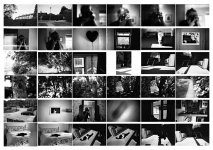
These contact sheets are straight off the scanner - no pp/cropping/tidying etc..

Ferrania P30 - Only shot one roll of this as I didn't like it. Had a long scratch running down the entire film which put me off. Also, it's quite pricey. Also it only comes in 35mm.
2020-05-31-FerraniaP30-R3M.jpg

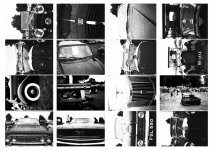
Washi S - I really like this film, but the contrast is very high in it. This also on 120 rather than 35mm. (35mm is available)
2021-08-14-washiS-645n.jpg

The downside to these films is they are both 50 ISO which means you need fast lenses and/or good light.

You can push film to get more contrast, but this is usually at the expense of more grain which won't help. Developers like Ilford DD-X really help to control the grain, but it's definitely "control" rather than "remove"

In terms of developers, I pretty much exclusively use Diafine and Ilford DD-X with occasional reliance on HC-110 (dil. B). The only developer I would actively avoid is Rodinal, mainly because it just makes some films look terrible in my opinion.
 
Last edited:
I'm using medium format (6X6).
Final production is via a scanner to TIFF files. It is a flatbed, Epson V850.
Historically I have used liquid concentrates for developing, predominantly Kodak T-Max.

Much as I can't really judge contrast from contact prints they do look pretty good to me.
The reason I'm asking about contrast is I'd rather have the cosmetic attributes I want right out of the dev tank so I don't need to do hours of post processing.

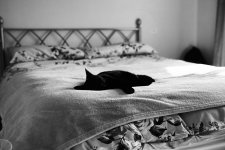
Any chance you could post a slightly larger image of the cat on the bed?
 
Last edited:
Any chance you could post a slightly larger image of the cat on the bed?
Sure. Single images can be a bit misleading, hence posting the contact sheet.... Which, when you can't see single images is also not overly helpful...

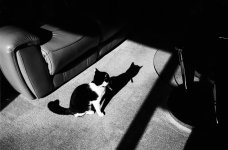
Ferrania P30 (35mm)
2020-05-31-p30-r3m-01.jpg
2020-05-31-p30-r3m-02.jpg

Washi S (120, 6x4.5)
2019-66-16-WashiA-645n-11.jpg
2021-08-14-washiS-645n-09.jpg
2021-08-14-washiS-645n-14.jpg2021-08-14-washiS-645n-13.jpg

If you are only thinking 120, then I'd heartily recommend Washi S.
 
Last edited:
There is almost no discernable grain on it and if you can focus properly (unlike me) it's super sharp.

I've developed this in both HC-110 and Diafine with no appreciable difference.

Screenshot 2021-10-18 162515.jpg
 
My favourite for nice contrast and low grain is Ilford Pan F which I have been using for over 50 years now. Used to love it developed in Unitol but that has not been around for many a long year. These days I tend to use ID11 (made up by me from the raw chemicals) or Ilfosol 3.
 
Sure. Single images can be a bit misleading, hence posting the contact sheet.... Which, when you can't see single images is also not overly helpful...

Ferrania P30 (35mm)
View attachment 333321
View attachment 333322

Washi S (120, 6x4.5)
View attachment 333320
View attachment 333323
View attachment 333325View attachment 333324

If you are only thinking 120, then I'd heartily recommend Washi S.
In truth, I like the look of the Ferrania.
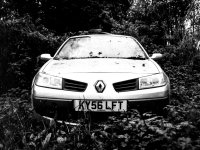
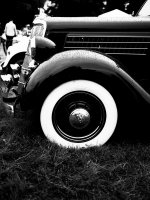
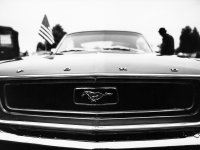
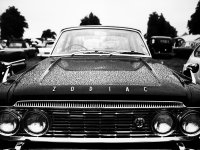
The look of the Zodiac pictures is largely where I'm targeting.
 
My favourite for nice contrast and low grain is Ilford Pan F which I have been using for over 50 years now. Used to love it developed in Unitol but that has not been around for many a long year. These days I tend to use ID11 (made up by me from the raw chemicals) or Ilfosol 3.
I guess it's a personal thing but Pan F was the film that put me off B&W.
Perhaps I need to revisit my processing.
 
As you say, it's all down to personal preference. I have been using Pan F (135 and 120) for so long it's almost a member of the family. I sometimes develop it in a reversal process to make black and white slides. I do use FP4 and HP5 occasionally when I need more speed but I find FP4 a bit 'grey' and HP5 rather 'stark'. I have just bought some ORTHO to play with, it might work well in my 1928 Zeiss Trona for authentic looking pictures. I have just loaded another roll of Pan F into the Bronnie to have a play with some trichromes.
The important thing is that we're still enjoying developing film, whatever our individual tastes may be.
 
Pan F is just beautiful, its slow but it always delivers, I can't buy Delta on its own, have to get a few rolls of Pan F to go with it.
I don't know that there is an uber contrasty film that is like that by default under normal processing, although that washi s looks way above average, I choose my contrast at print.
Blackened skys aside, Acros with a red filter borders uber contrasty, but that's with a filter and there is no old Acros.
 
My favourite film used to be Tri-X, but I'll have to find another as it's too expensive. Recently I've been shooting a LOT of FP4 and loving it. Just getting a bit gloomy for handholding, so currently on a roll of HP5, which I used not to like, because of grain in 135. Most folk love it n 120.

I've used Ilfosol 3 and HC-110. I really liked the former, but it only keeps for a year or so. HC-110 is expensive to buy but lasts for ages; current bottle has been going since 2018 and is still at the brim (though 3/4 filled with marbles as well!). Excellent results from HC-110 AFAICS.
 
...Acros with a red filter borders uber contrasty, but that's with a filter and there is no old Acros.
I've just shot a roll of original Acros at EI100 with an orange filter, and I was bothered by how low contrast it was! Devved by AG in Ilfotec DD, scanned by me. I did manage to rescue the shots in post but I wasn't happy!
 
These weren't a freaky rolls, different rolls, places and months apart, same method though, acros 1 @ iso50, red filter, xtol.
I liked it at the beginning but I got around to thinking they were a bit too contrasty and decided to lay off the red a bit.
I've definitely wet printed two of these and I remember at the time trying to push back the contrast, but they looked soooo flat..:(
 

Attachments

  • IMAGE28s.jpg
    IMAGE28s.jpg
    232.8 KB · Views: 7
  • IMAGE31s.jpg
    IMAGE31s.jpg
    234.8 KB · Views: 7
  • IMAGE36s.jpg
    IMAGE36s.jpg
    219.5 KB · Views: 7
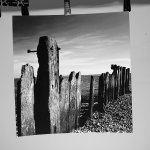
can't find anything on this puter anymore....lol, but this is definitely a wet print of acros with a red filter..
 

Attachments

  • DSC_3038s.jpg
    DSC_3038s.jpg
    377.3 KB · Views: 5
If you want high contrast, just extend the development times. But be aware that high contrast will make scanning more difficult unless you're happy clipping tones at the ends of the range, and longer development means more grain.

Faced with a requirement for high contrast/low grain, I'd use PanF (my favourite film anyway) for the low grain part and pay attention to the development time, being careful not to overdevelop. I'd fix the contrast at the scanning stage by applying curves on a frame by frame basis. This should give the best range of tones while preserving detail at both ends of the scale.
 
Back
Top