Ed Sutton
Suspended / Banned
- Messages
- 8,556
- Name
- Dave
- Edit My Images
- No
I don't know if this stuff is creative, but I'll post it here anyway and hope that as I describe the way this project developed over time might give some clues as to how ideas can be developed from chance beginnings and worked on from the results as they appear.
It all started back in 2011 when I bought a wide angle lens and fancied seeing how slow a shutter speed I could hand-hold it at and get sharp enough results. I did this by the side of a road as the sun set to make the tail lights of passing vehicles streak. I got down to 1/15th of a second. A year later I was out with the same lens when I was struck by a wild flower growing near the road and thought of making a few pictures where the flower was sharp and the passing cars were blurred, knowing that at 1/15th it would be possible.
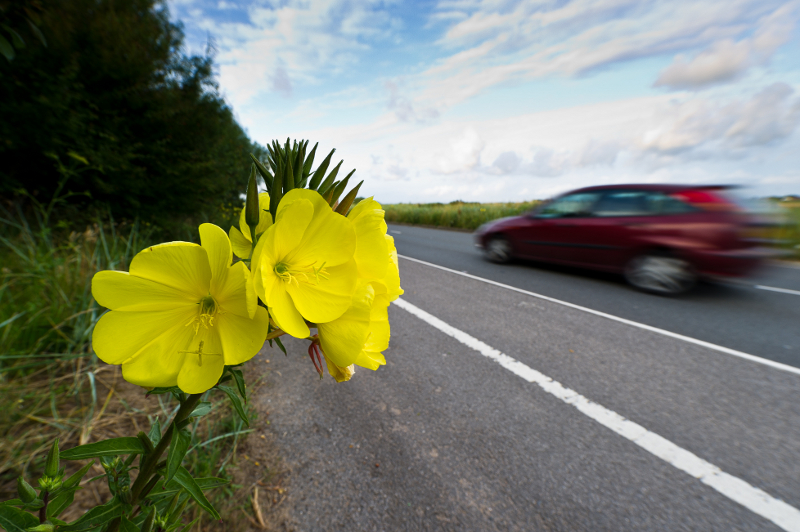
This then got me thinking about what the picture was saying. It seemed to me to tie in with other stuff I'd been doing relating to nature reclaiming environments that had been altered by humans. But also about the difference between the time frame we live in and the time frame that the natural world runs on, about plants growing slowly in one place while we rush about everywhere. Stuff like that. Also about more formal concerns such as colour relationships and shapes. I like to try and combine a concept with picture making in formal sense.
The next step was to try to make pictures which made these points in a more concise way. Initially I made the plants small and the cars large with a little environmental context by including elements like cats eyes and road markings. Some of the pictures were OK, but not really doing much for me. As autumn drew on the plants died back and I put the project to one side and eventually forgot about it.
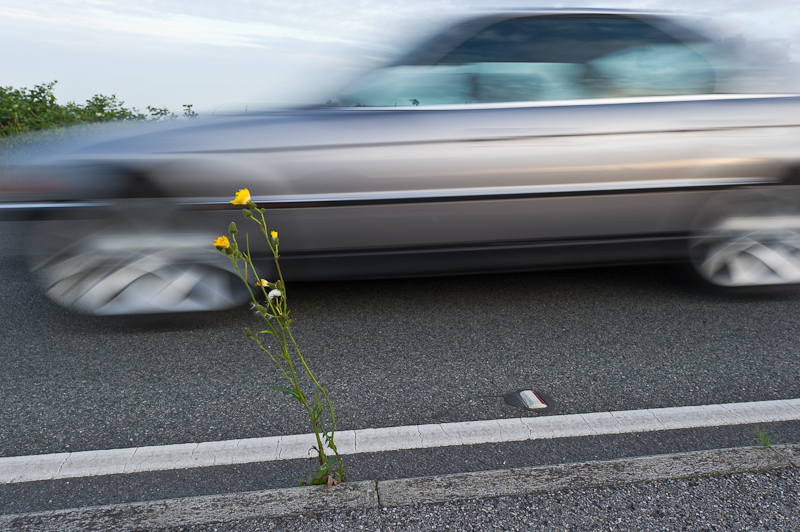
By chance, one day the following year I was out trying to do something else without much focus or success when I recalled what I'd done with the car and plant pictures and took a slightly lower viewpoint using a longer lens.
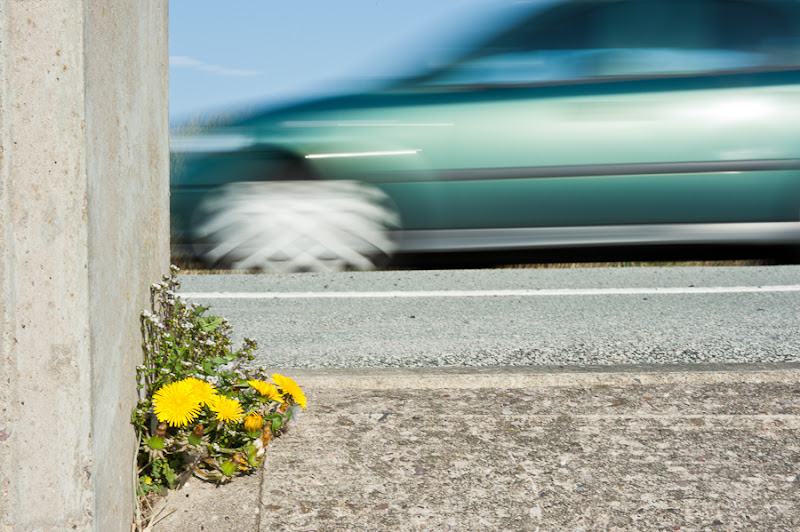
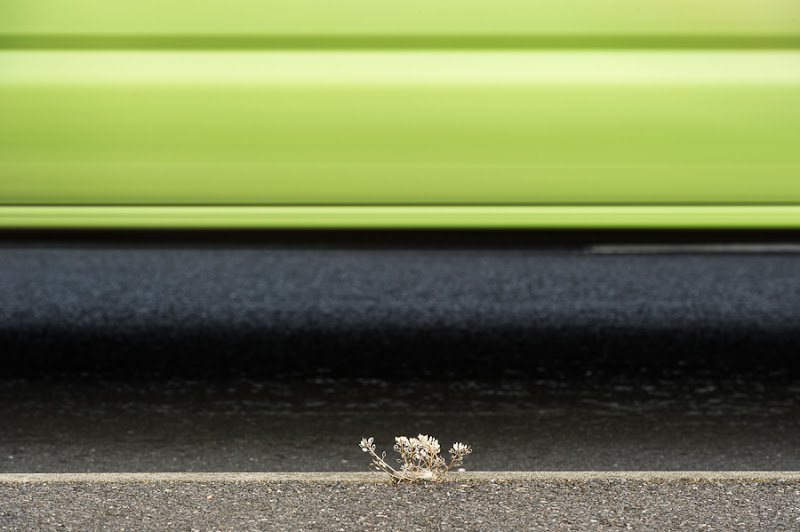
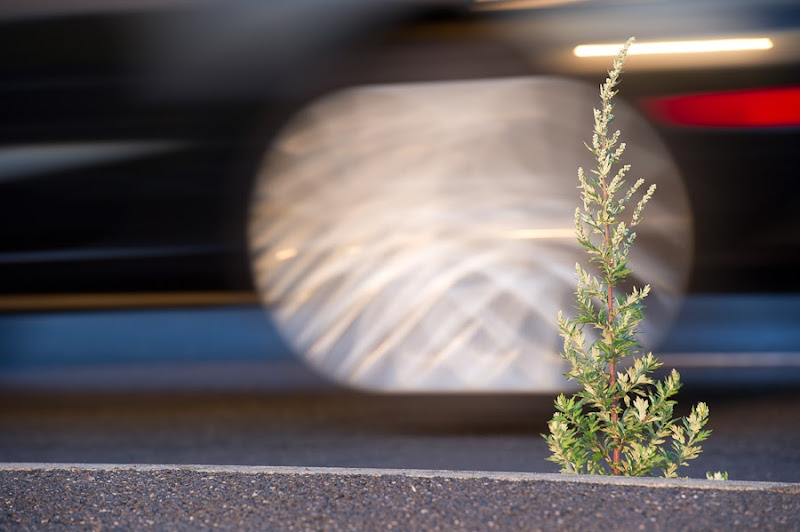
This picture provided the breakthrough I needed. Although not what I was after, the picture had more graphic impact. I realised I didn't need to show a whole car for it to read as a car. I'm not too quick on working out what I'm trying to achieve. If I could get at the same level, with a longer lens, I would be able to compress the space between the plants and cars, making them both large in the frame and therefore simplifying the images. It worked and I made a number of pictures which I thought succeeded. At this point I thought I'd taken the project as far as I could - I posted this next picture on here last year in a 'my best shot of 2013' thread.
Another year passed and once more I found myself without many workable ideas last summer and ended up by the road again with the long lens. I got down low and started playing around with slower and slower shutter speeds. Even with VR I began to struggle to hand-hold and keep the plants sharp, but the results were interesting. I returned with a tripod and a remote release. Not being a technical camera user this was where I got out of my depth! I was still getting camera shake. It wasn't until I was back home reviewing the shots on the computer that I twigged it was mirror slap... Previously I had been shooting in continuous mode thinking that was the best way to guarantee getting something in the frame as cars whizzed by. Now I was going to have to lock the mirror up and try to time the shots.
As it turned out this approach gave me a far better hit rate. Camera on tripod, mirror locked up, remote in hand I waited until a car was close and fired the release. More often than not I got a result. I was now able to drop the shutter speed to 1/10th. Any slower and the plants become blurred. I knew windy days made it impossible to work on this project but at really low shutter speeds the plants were registering movement caused by the draught from the cars. As I was shooting late in the day to take advantage of the sun's low angle, and I wanted to try to get shadows of the plants in some shots, there was too much light to maintain low shutter speeds. Not having any ND filters I dropped the ISO below base 200 and stuck a polariser on the lens. This wasn't ideal but it helped.
With all that done I got a number of pictures which I was pleased with. They show how plants find their way into cracks in the man-made environment and the differences between natural and mechanical forms. In some the body of the car partially 'disappears' in the blur, perhaps hinting at the ephemeral nature of cars which get scrapped compared to nature itself. Maybe nobody else can see this? I think the best of them make pictures which are interesting to look at regardless of any 'arty b*****ks' I might write to explain them!
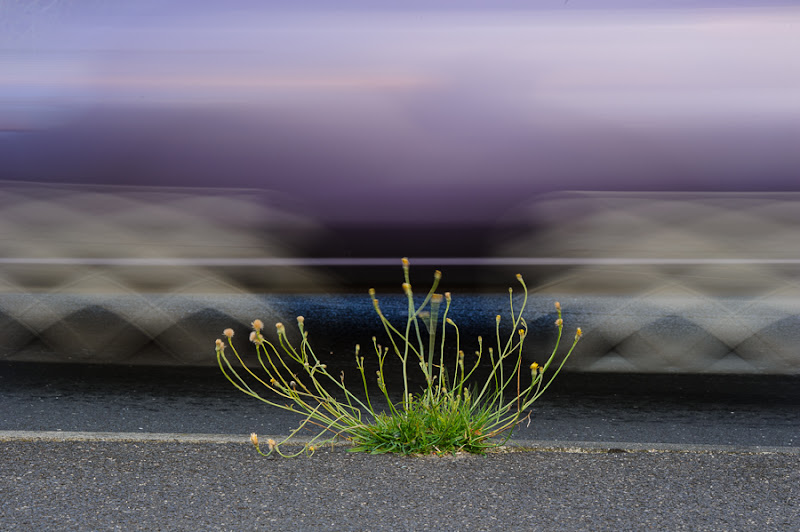
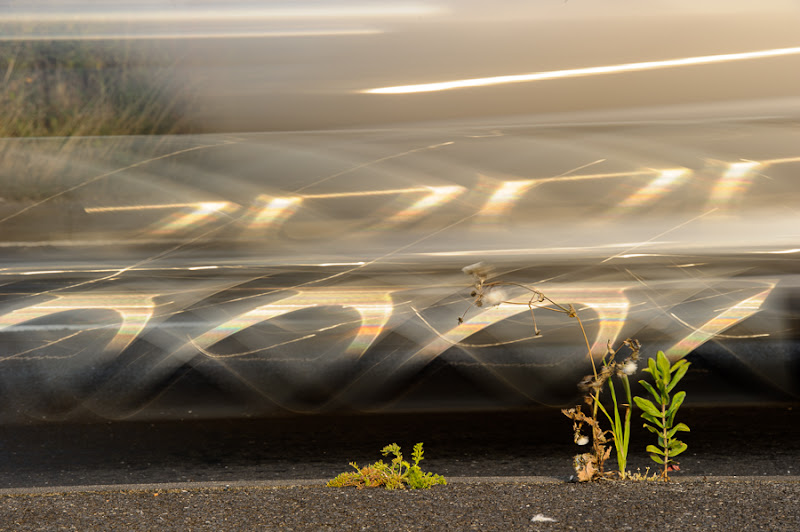
I suppose I could go out again next summer and add some more pictures to the set now I know what to do, but that would feel like covering the same ground and for me the journey is always more interesting than the destination. Then again some of the pictures (not shown here) could be developed in other ways. It's always difficult to know when a work is finished, but I think this project has run its course and those ideas might find their way into a different, but related, project.
Anyway, this is an example of the way I approach my photograph, yhow a random shot taken to try out a new lens became the germ of inspiration which lead to me working on an idea that kept me thinking, solving problems and shooting, on and off over a few years. For me the only way I can generate ideas (what others might call finding inspiration) is by taking photographs and seeing what they make me think of and about, which leads to making more pictures, and so on until there's a body of work based on some theme or other. Often the way this starts out, even the intention, can change as the photos are taken and fresh ideas materialise. Some projects run out of steam, some get picked up again later, some are over and done with quickly. There are no set rules.
It all started back in 2011 when I bought a wide angle lens and fancied seeing how slow a shutter speed I could hand-hold it at and get sharp enough results. I did this by the side of a road as the sun set to make the tail lights of passing vehicles streak. I got down to 1/15th of a second. A year later I was out with the same lens when I was struck by a wild flower growing near the road and thought of making a few pictures where the flower was sharp and the passing cars were blurred, knowing that at 1/15th it would be possible.
This then got me thinking about what the picture was saying. It seemed to me to tie in with other stuff I'd been doing relating to nature reclaiming environments that had been altered by humans. But also about the difference between the time frame we live in and the time frame that the natural world runs on, about plants growing slowly in one place while we rush about everywhere. Stuff like that. Also about more formal concerns such as colour relationships and shapes. I like to try and combine a concept with picture making in formal sense.
The next step was to try to make pictures which made these points in a more concise way. Initially I made the plants small and the cars large with a little environmental context by including elements like cats eyes and road markings. Some of the pictures were OK, but not really doing much for me. As autumn drew on the plants died back and I put the project to one side and eventually forgot about it.
By chance, one day the following year I was out trying to do something else without much focus or success when I recalled what I'd done with the car and plant pictures and took a slightly lower viewpoint using a longer lens.
This picture provided the breakthrough I needed. Although not what I was after, the picture had more graphic impact. I realised I didn't need to show a whole car for it to read as a car. I'm not too quick on working out what I'm trying to achieve. If I could get at the same level, with a longer lens, I would be able to compress the space between the plants and cars, making them both large in the frame and therefore simplifying the images. It worked and I made a number of pictures which I thought succeeded. At this point I thought I'd taken the project as far as I could - I posted this next picture on here last year in a 'my best shot of 2013' thread.
Another year passed and once more I found myself without many workable ideas last summer and ended up by the road again with the long lens. I got down low and started playing around with slower and slower shutter speeds. Even with VR I began to struggle to hand-hold and keep the plants sharp, but the results were interesting. I returned with a tripod and a remote release. Not being a technical camera user this was where I got out of my depth! I was still getting camera shake. It wasn't until I was back home reviewing the shots on the computer that I twigged it was mirror slap... Previously I had been shooting in continuous mode thinking that was the best way to guarantee getting something in the frame as cars whizzed by. Now I was going to have to lock the mirror up and try to time the shots.
As it turned out this approach gave me a far better hit rate. Camera on tripod, mirror locked up, remote in hand I waited until a car was close and fired the release. More often than not I got a result. I was now able to drop the shutter speed to 1/10th. Any slower and the plants become blurred. I knew windy days made it impossible to work on this project but at really low shutter speeds the plants were registering movement caused by the draught from the cars. As I was shooting late in the day to take advantage of the sun's low angle, and I wanted to try to get shadows of the plants in some shots, there was too much light to maintain low shutter speeds. Not having any ND filters I dropped the ISO below base 200 and stuck a polariser on the lens. This wasn't ideal but it helped.
With all that done I got a number of pictures which I was pleased with. They show how plants find their way into cracks in the man-made environment and the differences between natural and mechanical forms. In some the body of the car partially 'disappears' in the blur, perhaps hinting at the ephemeral nature of cars which get scrapped compared to nature itself. Maybe nobody else can see this? I think the best of them make pictures which are interesting to look at regardless of any 'arty b*****ks' I might write to explain them!
I suppose I could go out again next summer and add some more pictures to the set now I know what to do, but that would feel like covering the same ground and for me the journey is always more interesting than the destination. Then again some of the pictures (not shown here) could be developed in other ways. It's always difficult to know when a work is finished, but I think this project has run its course and those ideas might find their way into a different, but related, project.
Anyway, this is an example of the way I approach my photograph, yhow a random shot taken to try out a new lens became the germ of inspiration which lead to me working on an idea that kept me thinking, solving problems and shooting, on and off over a few years. For me the only way I can generate ideas (what others might call finding inspiration) is by taking photographs and seeing what they make me think of and about, which leads to making more pictures, and so on until there's a body of work based on some theme or other. Often the way this starts out, even the intention, can change as the photos are taken and fresh ideas materialise. Some projects run out of steam, some get picked up again later, some are over and done with quickly. There are no set rules.