Auto Iso sensetivity

Hoogle

Suspended / Banned
Messages
55
Edit My Images
Yes
Hey there Guys I Think I have selected something in my menu options under auto ISO Sensetivity it is currently set at minimum 200 maximum 3200, and As I am shooting a Nikon D5000 it does not cope with such high Isos that well.

I was Taking some pictures yesterday varying isos from 100 - 400 however when I got home and opened them up in Bridge they were all shot at iso 3200 and all though the pictures looked great on my screen on my camera when I loaded onto computer and looked at them at 100% they had really bad noise even to much for lightroom and photoshop various filters to remove and keep detail.

So I had a play last and figured it must have something to do with my auto Iso settings and I shoot Manual, The only way I could rectify this issue and shoot with the ISO I wanted I had to disable auto Iso.

So My question is should I limit my auto Iso to lo1 to 1000 or carry on as I am with it switched off so I dont have to come home and realise all my images are ruined due to Noise.
 
it seems to only work in aperature, shutter priority or manual mode.
 
I had a similar problem with a friends d5000 a few weeks ago while studio shooting, Ialso thought that once you switch to manual ALL auto features are turned off, but it seems this is not the case.

The only way we managed to turn it off was by turning ISO sensitivity in the menu options .... Took a while to find but it is there
 
Auto iso will indeed carry on working in manual mode. Basically, you set the aperture and shutter speed and then the camera will up the iso as far as you've allowed it to try to get a 'good' exposure. Once it runs out of iso (in your case 3200) it will start underexposing and noise will get even worse.

My gut feeling is that there wasn't enough light for what you were asking the camera to do. The way around this would have been to select a lower shutter speed or wider aperture. Of course, if it's dark enough you eventually begin to ask the impossible and have to give up and go home.

Persevere with it though as I'm rapidly coming to the conclusion that auto iso and manual is one of the best things about shooting Nikon. It's brilliant when used to it's strength.
 
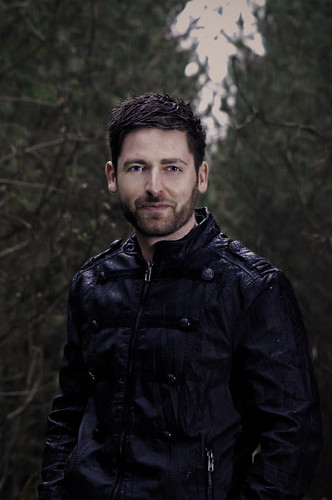
Ok this is 1 of the pictures I only got to take 5 once we got to the location the rain started coming down heavy. I should also point out this is only the 2nd opportunity I have had to shoot portraits I would really like to get into it however seem to have a severe lack of volounteers so dont be to harsh on my composition etc Still getting use to off camera flash and posing whilst having good composition. And If I had more time than literally 2 mins to shoot I am sure I would have come up with a better picture but sometimes you can only take what is given.

The PP has reduced the noise a lot and in this particular photo I like the grainy efffect when you are zoomed out but when you get close or if I wanted a large print it looks terrible.

I had the iso set to 200 Camera automatically set it to 3200
shutter speed was 1\160
no exposure compensation
Aperature f13 ( I know it is a bit high but I wanted to darken background and have not invested in ND filters yet)
I used Nikon SB600 speedlight set to full power

And it was daylight but very overcast but I dont see why the camera would need to boost the iso with these settings and a speedlight and reflector.


Jon Processed by Hoogle/PSG, on Flickr
 
I had the iso set to 200 Camera automatically set it to 3200

So is it like a safety shift feature where it will override your settings if it thinks you're being stupid? If it's that I'd turn it off completely if possible and forget it's even there, doubly so if you usually shoot manual as I can't see the point of using manual if you're going to let the camera adjust ISO itself.
If it's just normal auto ISO (i.e. it works the same way as the shutter or aperture settings do when they're automated) I don't understand how the camera can pick 3200 when you've "set" 200.

Have you changed the exposure or anything like that in post processing for the shot you've shown? If that's at 3200 and you were wanting 200 you'd have underexposed it massively which would explain why the camera wanted to use 3200.

You're also better off using the shutter speed to darken the background as it only affects the ambient light and not the flash (until you start getting into sync problems). Using the aperture or ISO won't make any difference as the flash will just increase its power to compensate until it's firing at full power, once it's at full power you may find the background is getting dark because the flash isn't powerful enough to illuminate it but you can save yourself some batteries and give yourself more flexibility with other settings by reducing the power of the flash and moving it closer as that will give the same effect.
Though you only have another third of a stop before you hit the maximum sync speed for your camera unless the SB600 has something equivalent to Canon's High Speed Sync.

It's a good idea to learn to look at the numbers you're getting the viewfinder while shooting or at least the numbers when reviewing on the screen, then you'll realise you have a problem before getting home and being unable to redo the shots. It'll save you losing shots due to getting shutter speeds you can't hand-hold, ISO settings which have huge amounts of noise or aperture values too large to get your subject in focus.
 
Last edited:
Ok this is 1 of the pictures I only got to take 5 once we got to the location the rain started coming down heavy. I should also point out this is only the 2nd opportunity I have had to shoot portraits I would really like to get into it however seem to have a severe lack of volounteers so dont be to harsh on my composition etc Still getting use to off camera flash and posing whilst having good composition. And If I had more time than literally 2 mins to shoot I am sure I would have come up with a better picture but sometimes you can only take what is given.

The PP has reduced the noise a lot and in this particular photo I like the grainy efffect when you are zoomed out but when you get close or if I wanted a large print it looks terrible.

I had the iso set to 200 Camera automatically set it to 3200
shutter speed was 1\160
no exposure compensation
Aperature f13 ( I know it is a bit high but I wanted to darken background and have not invested in ND filters yet)
I used Nikon SB600 speedlight set to full power

And it was daylight but very overcast but I dont see why the camera would need to boost the iso with these settings and a speedlight and reflector.


Jon Processed by Hoogle/PSG, on Flickr

Firstly, nowt to be ashamed of with that shot. It's really nicely done and exposure looks just about spot on.

I hadn't realised you were using off camera flash. Are you using the built in flash to trigger it or something else? Nikon's consumer bodies auto iso can behave very strangely when using a flash. I'm just wondering if you have succumbed to it. Basically, you'd expect the camera to keep the iso as low as possible and balance the exposure with the flash but it actually does the opposite and cranks the iso up high and turns the flash right down. I've never heard an explanation for why this happens.

If however you were using the flash as just a 'dumb' optical slave manually and the camera didn't know it was there I think the issue is that the camera is therefore exposing for what it thinks is a very dark scene and is simply trying to deal with it by throwing as much iso at it as possible. The way to avoid this would be to turn auto iso off when doing flash photography. It'll put the control back in your hands at least.
 
I have not got the hang of the of camera flash so no I didnt trigger it using the pop up flash I used a radio transmitter However I had the flash in manual mode As I kind of understand it However So I hear I should be using TTL so it all communicates with each other. I hope to be upgrading my lights and was looking at getting 2 more speedlights maybe go full out and get the SB910 but money is tight at the moment so if I can afford 1 of those I certainly cant afford a 2nd 1 so possibly looking at an ebay alternative but not sure how they work with TTL Despite claiming to be compatable. So thought if I could learn the basics in manual I shouldnt have a problem mix and matching lights.

But hopefully even if I get a 2nd SB600 I thin I can still use the SB910 as a trigger but seems a bit of waste to have that as a trigger as I wouldnt utilise the on camera flash.

I want 3 off camera speed lights Possibly 4 in the future so I can have a really flexible portable studio light set up however I think My money would be more wisely spent on a new camera.

I love my Nikon D5000 cant vault it for the money but when I bought it and I had the money I didnt know where it would take me I was just interested in Photography and after owning it for 2 years now I would say I am addicted to it But I did not Know that at the time otherwise I would have spent twice or 3 times the ammount on my camera.

At least my redundancy package was not wasted as my camera is more than adequate for what I am using it for. But Lacks some things I want but not even sure If i need them lol.

We can all dream of a better system though cant we. Realisticly I think My next camera unless I get some serious cash Soon will be the D700 it is getting old now but still an impressive camera.

Or maybe I could start a war and say I could transfer to Canon as I seem to like there picture quality but I am sure Nikon and Canon cameras are not the cause of them it is the lens.
 
Don't use auto ISO with flash :thumbs:

If I had a list of top ten Nikon tips, this would be somewhere on there.

Its nothing to do with your camera body, they all do it. Just avoid it.
 
Last edited:
Is there a way to limit your auto ISO to a 1600 top range. I've just got a 5D MkIII and limited my ISO to 12800 which still gives great quality photos at that range.
 
use menu in D5000 to either turn auto iso off or limit to a max of 800. I have a D5000 and althought it is ok at 1600 i wouldn't go that high.
What I do for iso is to use the function button as an ISO select instead of letting camera choose.
 
Back
Top