Astrophotography advice?

_belial

Suspended / Banned
Messages
676
Edit My Images
No
Hi all,

I've wanted to take some pictures of some DSO's for a while now, but am unsure about the best way to go about it.

I have a Sky-Watcher SkyMax 127 (127mm f/1500 Maksutov), and have managed to get some great lunar shots, and managed to view some of our near neighbours. But as of yet I've failed to photograph even the likes of M42 and M31 with my D300 or D700 attached to the scope.

I was wondering what the best option would be ?

*) Get one of those little CCD imagers and stack an image from a captured video whilst the scope is tracking?

*) Find a way (advice needed on what to use?) to piggy-back the D700 to the scope whilst it's tracking and use 300mm, take a load of shots then stack those?

Or should I get rid of the skymax and get something on an EQ mount instead of the alt-az one?

Many thanks
 
Not saying it can't be done with a Mak - but all things that make Maks great for luna an planatary work, tend to work against them for DSOs.

Planets are small, but very bright - which means magnification is more important than light gathering. DSO are the complete opposite - big, but dim. You'd almost certainly need a reducer to increase the FOV (I seem to remember that Celestron make a reducer that's designed for DSO on maks).

You'll probably be fine with bright ones like M42, but will struggle with the dimmer ones. While stacking is an option - you'd need a lot of frames and some longish exposures a CCD would be better than a DSLR, but you could easily escalate cost by taking that route(which brings the whole tracking thing to the fore).

Generally speaking the light gathering abilities of a newtonians is really the tool for this type of job/
 
Thanks Paul, I was hoping I wouldn't have to hunt a new scope though, but seems like it may be a better option in the long-term then. What about piggy-backing my DSLR onto my skywatcher? I've seen this mentioned a few times, how is it done? How do you get the camera lined up with the telescope too?

Thanks
 
Although it is perfectly possible to image DSO's on your Mak, it really isnt the best thing to use as it has a very narrow field of view and long focal length. A lot of DSO's are quite large and best viewed at low power with a short focal length. ( F8 or less would be good)
You could try using a focal reducer, but you may end up with a lot of vignetting.

My first thought would be to get a more suitable scope ( 8" driven newtonian?) on an EQ mount, you should be able to image successfully with your DSLR then.
Allan
 
Thanks Allan.

Would something like this (i'll get a motorised mount) be more suitable then?

http://www.harpersphoto.co.uk/product/skywatcher_200p_eq5_pro_synscan/

What would I need to piggy-back my DSRL on it as well? I have the t-rings and adapters etc for taking images prime through the telescope, but i'm also interested in piggy-backing my DSLR on it.

Many thanks
 
DSOs will require a EQ mount (which I don't think you have on the Mak127 - think it's an alt-az mount) and most people start imaging DSOs with a small refractor (as you can get a lot in and the tracking accuracy doesn't need to be too spot on.

If you're serious about wanting to do this (rather than just trying it) head over to http://www.stargazerslounge.com and start poking around over there. Some brilliant DSOs on there.
 
You'd be better off with an HEQ5 - much more sturdy. Have a look at: http://firstlightoptics.com/products.php?cat=46 and I'd be looking at the SynScan versions of the HEQ5/EQ6 (the HEQ5 is much sturdier than the EQ5) at a minimum. Astrophotography is 90% mount/mount setup and 10% camera/scope combination.

Personally, I wouldn't start out with a newtonian for astrophotography.


What would I need to piggy-back my DSRL on it as well? I have the t-rings and adapters etc for taking images prime through the telescope, but i'm also interested in piggy-backing my DSLR on it.

Many thanks
I think your best bet would be to make a custom dovetail to mount your DSLR and mount it directly on the mount.... You could mount this to the clamping rings of the 'scope too if you wanted.
 
Personally, I wouldn't start out with a newtonian for astrophotography.

What would you recommend? It's a minefield out there :)) I'm just reading up on posts in that stargazerslounge now so thanks for the heads-up.

I know a friend of mine had the EQ5 mount, and although was an excellent mount, the only disadvantage was that he was pretty much restricted to using it in his back garden as was way too big to put in the car for example and take it somewhere really dark?
 
What would you recommend? It's a minefield out there :)) I'm just reading up on posts in that stargazerslounge now so thanks for the heads-up.
I'd start with a low cost refractor. I started with a Celestron C80ED.There are a number of 80mm refractors ranging from about F6.5 to F8 which you can use depending on budget. The problem with an 8" newtonian is that it needs a bigger mount as it's heavier and more unwieldy and your image plane has more coma than a longer focal length refractor (so your stars will be egg shaped towards the edges of the frame). You'll also need a 2" extension tube (to reach focus) and something like a MaxDSLR adaptor for the Nikon.

I know a friend of mine had the EQ5 mount, and although was an excellent mount, the only disadvantage was that he was pretty much restricted to using it in his back garden as was way too big to put in the car for example and take it somewhere really dark?
Did he have the EQ5 or HEQ5? I had an EQ6 for a while, that was as heavy as, but very sturdy. The problem with astrophotography is for the dim stuff you need to do lots of 5+ minute exposures and tracking and stability is 90% of the problem. If you have more than a passing interest in astrophotography, you really should invest in the best mount you can afford - whether it is heavy and unwieldy or not. If you start with a £300-£500 mount you will either get disillusioned and give up very quickly as the mechanical problems with the cheaper mounts show in your photos or you will inevitably buy a £700-£1000 mount.

Astrophotography is both very demanding and, unfortunately, expensive to do well (which is why I gave it up ;))
 
There are a number of 80mm refractors ranging from about F6.5 to F8 which you can use depending on budget.
Just as an aside. Whichever 'scope you end up with, focus and maintaining it as you track across the skies is important. A good focuser is mandatory - most choose something like a good 10:1 crayford which can be expensive if you buy as an after market upgrade (I was looking at a Moonlite for my C80ED which was about £250 IIRC). Some of the more expensive 'scopes come with much better focusers fitted as standard.
 
I agree with arad85 "astrophotography is 90% mount + 10% scope"

Invest in a driven equatorial mount first and use a short telephoto lens say 135mm.
When you've experimented with that and got some nice images :) , buy a short focal length refractor with a focal length of 500mm or less.
That way you'll be able to take reasonably long un-guided exposures of several mins each
You'll soon get some decent results without the frustrations of pointing / tracking and guiding a larger instrument.

Then be prepared to invest in even more ££ if the bug catches hold :nuts:

http://ukastroimaging.co.uk is aslo a good astrophotography forum to look at too.
 
Thank you all for the advice, it's certainly given me food for thought. If I was to go out and get the driven heq5, would I be able to plug the finder from my syscan into it for it to auto track?
 
Thank you all for the advice, it's certainly given me food for thought. If I was to go out and get the driven heq5, would I be able to plug the finder from my syscan into it for it to auto track?

I think that you have received some good advice .... However, please remember that the fantastic images you see in the mags and on the web have gone through some very clever processing and quite often expensive software :thinking: .... You will never get the stunning images via equipment alone ... you really should consider the processing too!
 
Of course there's also the more mobile approach that can be taken, especially if you are using a DSLR.

You have 28mm and 50mm lenses that are fine for widefield and could of course add a couple of cheapish manual focus primes such as 135mm f2.8 and 200mm F4 or faster.

This item will allow you to track pretty darn well once you get the hang of polar alignment and means no 25KG + mounts to lug around.

Having gone the fixed pier route before myself, where I mobile I would be going light and portable.

http://www.astrotrac.com/

http://www.youtube.com/v/4WfIM9HeGPU&hl=en&fs=1
 
Last edited:
ooh that looks pretty impressive Ian, have you used one of those? Looks ideal (and portable) for starting out without spending a fortune.
 
Of course there's also the more mobile approach that can be taken, especially if you are using a DSLR.

You have 28mm and 50mm lenses that are fine for widefield and could of course add a couple of cheapish manual focus primes such as 135mm f2.8 and 200mm F4 or faster.

This item will allow you to track pretty darn well once you get the hang of polar alignment and means no 25KG + mounts to lug around.

Having gone the fixed pier route before myself, where I mobile I would be going light and portable.

http://www.astrotrac.com/

http://www.youtube.com/v/4WfIM9HeGPU&hl=en&fs=1


Good advice :thumbs:

Just to add to my comment about processing, here's a couple of shots at 16mm taken about ten days ago:

Untouched (except resize etc) straight from camera


IMG_2010_09_08_5139_untouched by SteveP!, on Flickr

Re-processed to bring out some detail and colour

IMG_2010_09_08_5139 by SteveP!, on Flickr

I'm certainly not good at processing and the shot is just a single thirty second exposure and suffers a bit .. i.e. noise, trailing etc :) I just hope it shows the effect of processing required to bring out detail :cool:
 
No never used one and cant now but I've heard nothing but good things about them, partnered with a 410 geared head and ball head they work great.

Processing wise, registax (free) and photoshop are fine, though noel carboni's action set can really help

PS nice shot Lucy
 
Last edited:
No never used one and cant now but I've heard nothing but good things about them, partnered with a 410 geared head and ball head they work great.

Processing wise, registax (free) and photoshop are fine, though noel carboni's action set can really help

PS nice shot Lucy

Thank you Ian :D The point I was making was that whatever gear the OP gets? He will still need to learn how to process the files? DSS is also excellent and free :thumbs:

I have an AstroTrac and it really is excellent, but expensive, then add to that the cost of two decent heads, as you rightly point out and a sturdy tripod ... it will cost about £1000 including polar scope :eek: Very nice kit though!
 
Thanks for all the advice everyone, it's very much appreciated. I'm really fancying the idea of that astrotrac, as it's reasonably cheap entry point into astrophotography but also means I could buy some new glass for my camera i could use for astro + other areas.

I've taken a few just on my tripod before but they've been limited to either wide starfield or startrail images, that astrotac (coupled with a decent wide-aperture 300/400mm) would give me the chance to try to capture some nearby DSO's

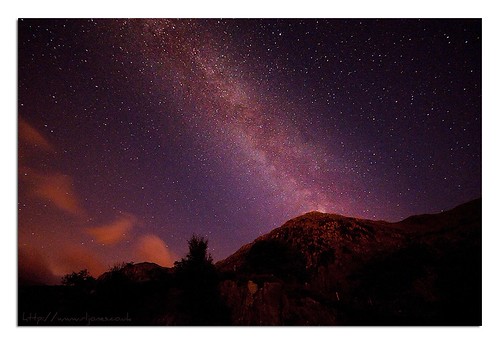
This one's just on a tripod in Llanberis with my D300, f/4 30secs, ISO 3200, bit of post-pro in photoshop.

3748409981_4531ec9396.jpg


I've not had a chance to try my D700 for shots like that yet
 
Thank you Ian :D The point I was making was that whatever gear the OP gets? He will still need to learn how to process the files? DSS is also excellent and free :thumbs:

I have an AstroTrac and it really is excellent, but expensive, then add to that the cost of two decent heads, as you rightly point out and a sturdy tripod ... it will cost about £1000 including polar scope :eek: Very nice kit though!

I've used DSS before, excellent bit of kit. I did try "Iris" once but was a bit too over-compllicated for what I needed at the time. All my stacked startrails are processed with either use DSS or "startrails.exe".
 
If you mount your camera on the AltAz mount, and use between 250 and 400 mm, you'll get some good results on M31, with the ability to get up to 2 minutes exposures (as long as the target is low in the east or west (which it is at the moment). The exposure time comes down the higher in the sky or further North/South the target gets. A dovetail will set you back about £15

http://firstlightoptics.com/proddetail.php?prod=swdovetails&cat=62

The medium one here will work nicely. It's drilled with a pair of standard tripod thread holes in the centre, and will allow you to reach reasonable balance. Aim to get it slightly tail heavy. It'll be a lot better than a camera tripod, but... not as good as a EQ mount. I use the HEQ5 with a C80ED scope mounted on it. I've still got the cheap and nasty stock focuser on it, but teflon tape improves it tremendously.

Even with an unmoddified camera, mounted on an AltAz mount (limited to 40 seconds as the target was overhead) I've captured the infrared emissions from the bubble nebula.

These were both shot with a 400mm cheap scope on a really cheap AltAz mount...

M42
m42repro2.jpg


M52 and Bubble Nebula
m52bubble.jpg


My M31 on this setup has serious vignetting but... (I know how to deal with this easily now)
m31final.jpg
 
That M42 shot is amazing John, really spectacular stuff!
 
Hi Andy... ;)...

Thanks, It was the fourth reedit of the data (early on in when I had no clue on how to process deep sky images, I'm not much further on, but I seem to be able to get results faster now (in under 2 or 3 hours of processing instead of 8 or more)... The M42 was 34 exposures, mixed lengths.

I'd say, put your D50 and the Siggy 70-300 on a dovetail... stick it on the mount, lock the lens to 300mm (it's often worth using either masking tape or bluetak to lock the zoom and focus rings) and you should be able to get some good results. You'll need to play with the exposures to find what you can get away with. If you get a little star trailing, but so it's only visible when you're pixel peeping, you will get away with it when you stack, ideally you don't want any. If you go longer than that, you will get field rotation (the corners rotate), but this isn't an issue over frames in the session, as the stacking software will deal with it. You can even push the camera settings far harder then you would think, as things like hot pixels will be removed in the stacking process if you have enough exposures to work on.

I've got better images now, but I'm using a much better quality optical scope, and an EQ mount nowadays.

As for the Mak, if you get http://go.talkphotography.co.uk/?id...k/forums/showthread.php?p=3008457#post3008457 and http://go.talkphotography.co.uk/?id...k/forums/showthread.php?p=3008457#post3008457, it'll work pretty well on the planets and moon.
 
Back
Top