Are 110 film cameras worth it ?

BADGER.BRAD

Suspended / Banned
Messages
4,252
Edit My Images
Yes
Hello all,

I for some reason and I'm not sure how I got there ( I was trying to find the focal length of a Diana camera) I ended up on the Lomography site and looking at 110 film. This got me thinking I never tried it when it in the film days so I should now especially with the large amount of cameras about. From this it got me wondering if there were any of you that ever us 110 film, Who is the best for processing a few films (Colour) What cameras should I look out for ( I like something pretty wide angle) ? How does focal length compare with 35mm ? Are they all square formats ( I like square) ? How many shots will I get ( cannot remember if it was 12 or 24 ?)
 
Negative size is 13x17mm, Amateur photographer magazine did an article on 110 film cameras, luckily it's available online.

 
Hello Badger Brad, looks like you are having a sub miniature moment. Welcome to the club.
Most 110 cameras were tat to be blunt. The good ones were the Pentax 110 SLR, The Rolli A110 and a couple of the Minoltas. I recommended a retailer in your other post about Lomo, give them a call if only for a chat you'll be amazed what you learn. Also consider a 16mm camera which is similar to 110 but a bit more diy when it comes to loading films in cassettes etc which is a good thing as it gives you more choice with film, you can cut down any 35mm or even 120 film and spool it into a 16mm cassette in a changing bag of course. This means you can shoot FP4 plus if you like but also Adox CMS 20 or Portra 160, anything you like. Minolta started with 16mm cameras, I've got three or four of them around me as I type this and they are very cool.
Then you get to the darkroom side of things, you really are better off doing it yourself by and large. If you want to print your negs look out for a Mamiya Enlar Head, it replaces the lens of a "normal" enlarger with a lens and diffuser optimised for 110/16mm/8x11
 
I had one of the better ones, think it was a rolli but cant remember now, quality wasnt bad, but I switched to half frame olympus, that was miles better and 70+ on a roll of film.
 
I haven't been using film for a while until I recently took my Kodak Brownie no2 out and in the past couple of days my Holga ( Only 3 square frames used so far) but will defiatley give it a go for a bit of fun . I had forgotten about half frame cameras and they were on my original list of things to try.
 
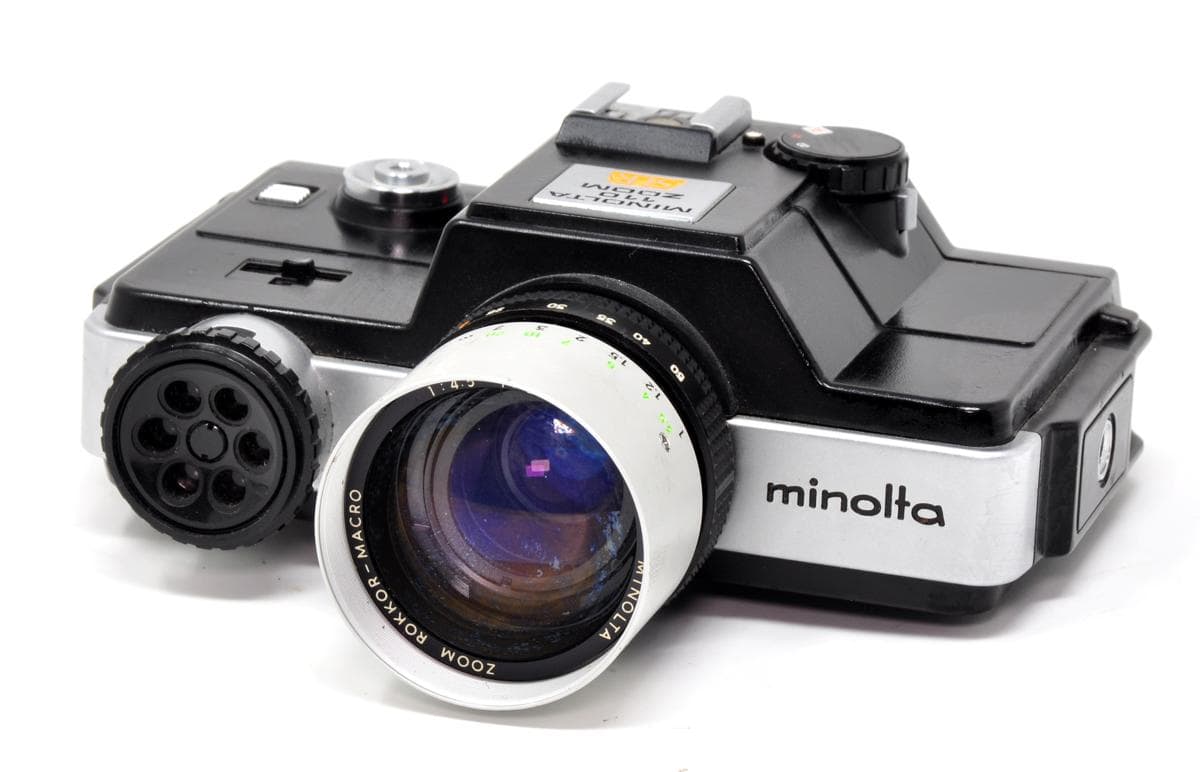
I've got a film in the Minolta 110 zoom SLR, aperture selection and auto shutter speed, I bought as an engagement present for my wife 41 years ago. Was fine for snapshots but I preferred my 35mm SLRs and 120 TLR.
 
I had a Pentax Auto 110 which I used occasionally. The reason I bought pit in the first place is that I had a 24mm (I think) Pentax lens on a digital camera for my BBC Model B computer (circa 1982), so I thought it would be interesting to buy one of the cameras. The camera itself was superb, I got all the lenses. However, especially in retrospect, the camera's only advantage was its portability. Even with those superb lenses the tiny negatives didn't produce great results, which I confirmed when I scanned them. Wayne is correct about half frame, Olympus in particular, I had an Olympus EE3 which I used as a kind of notebook camera, I only disposed of it when the meter got a bit dodgy. But, recently I got hold of an Olympus Pen, all manual controls, and I really enjoy using it, compared to 110 half frame 35mm is a good compromise between portability and results. I often carry it with me alongside one of my medium format cameras.
 
There were problems with 110 from the outset, which were widely reported in the photography magazines in the early 1970s.

The main cause was held to be the cartridge's design, which it seems did not reliably hold the film at the correct focal plane. I managed a trial with the first of the Minolta designs and the results didn't impress me. :(
 
Like Peter, I had a Pentax auto 110 ( amongst other less impressive models. )’
Yes it had a 24, 50 and 80(or 85)mm lens as well as auto winder andflash

It was fun to use but like all the 110 formats, the resulting negatives were barely sufficient to offer a decent 6x4 print.

As a kid I in the 70s I had one for school trips but the Kodak 126 instantamatics were better ( larger negative helped considerably)

Then of course we had the disc camera…..don’t even go there! :oops: :$:LOL:
 
Like Peter, I had a Pentax auto 110 ( amongst other less impressive models. )’
Yes it had a 24, 50 and 80(or 85)mm lens as well as auto winder andflash

It was fun to use but like all the 110 formats, the resulting negatives were barely sufficient to offer a decent 6x4 print.

As a kid I in the 70s I had one for school trips but the Kodak 126 instantamatics were better ( larger negative helped considerably)

Then of course we had the disc camera…..don’t even go there! :oops: :$:LOL:
A big part of the reason for the poor quality prints upon introduction in the 1970s was that Kodak designed an enlarging lens specifically optimised for producing prints from the small 16 mm frames of 110. Unfortunately, the majority of photo labs didn't bother buying this enlarging lens and just used the standard ones that were nowhere near optimal and the quality suffered as a result. The introduction of T-grain elusions in the mid 80s (which drastically improved the even smaller Disc film negatives, the films for which were usually used as test beds for new technologies) certainly helped and the last generation of negative emulsions in 110 certainly gave quality high enough for decent prints, at least at sizes up to 9"x6" (I have a Pentax Auto 110 that I put several rolls of frozen Fuji Susperia 200 though a few years ago and they were pretty good, I'll try and dig out the scans).

EDIT: I've misremembered, the enlarging lens problem was for disc film not 110 :(
 
Last edited:
I had a Pentax Auto 110 which I used occasionally. The reason I bought pit in the first place is that I had a 24mm (I think) Pentax lens on a digital camera for my BBC Model B computer (circa 1982), so I thought it would be interesting to buy one of the cameras. The camera itself was superb, I got all the lenses. However, especially in retrospect, the camera's only advantage was its portability. Even with those superb lenses the tiny negatives didn't produce great results, which I confirmed when I scanned them. Wayne is correct about half frame, Olympus in particular, I had an Olympus EE3 which I used as a kind of notebook camera, I only disposed of it when the meter got a bit dodgy. But, recently I got hold of an Olympus Pen, all manual controls, and I really enjoy using it, compared to 110 half frame 35mm is a good compromise between portability and results. I often carry it with me alongside one of my medium format cameras.
I never had one in film days, but I now have a Pentax Auto 110. The lenses are adaptable to MFT (all mine cover the sensor entirely, not surprising as sensor size is similar to 110 film).
Lenses are quite good and really small - the 24mm/2.8 only weighs 12g!

I thought 110 film was long since discontinued so I've never even considered using the camera/motor winder set up.
 
Back
Top