Beginner Am I Getting Ahead of Myself?

dhaywood17

Suspended / Banned
Messages
44
Name
Duncan
Edit My Images
Yes
Hi all,

First post here so please be gentle.

I currently have a Panasonic G3 with the kit 14-42mm lens which I'm really pleased with as a step up from a point and shoot compact. It already has me thinking about aperture and shutter speed when I'm taking shots. I know it's totally fine for me while I'm improving my composition from family happy snaps to something a bit more artistic. Initially I'll be looking at landscape and portraits (family stuff) but I also had, and will be trying again, a bash at astro while on holiday in Northumberland which I really enjoyed.

I know that micro 4/3 is less than ideally suited for astro. I was really pushing it in terms of shutter speed and ISO as I was getting quite a bit of noise on the images. From what I can tell this is pretty much down to the 2x crop factor of the sensor. The question is am I better to go with a different lens for the G3 or sell it while I can still get a bit for it and invest in a DSLR from one of the main brands? Looking around there doesn't seem to be too many lenses available for the G3 and I'm never sure what other brands are compatible. Obviously there are far more Canon and Nikon users and by default far more lenses both new and used available. And just to throw another line of thought I've been reading aboutt the Pentax K range as the thought of weather proof is appealing for some strange reason, and they also the have the GSP astro tracker available as either an add-on or inbuilt into a few of their units. Also, and bear in mind I don't if this is true or even useful, there are a huge amount of older k mount lenses that can still be used allegedly (no idea if any of the old lenses would be any good).

So, to summarise that lengthy bit of waffle, I guess I'm canvassing opinion on whether I should stick with what I've got for now or just bite the bullet and get something more modern and suited for my needs (astro) that will allow me to grow with it both in terms of technique and equipment?
 
I know that micro 4/3 is less than ideally suited for astro. I was really pushing it in terms of shutter speed and ISO as I was getting quite a bit of noise on the images. From what I can tell this is pretty much down to the 2x crop factor of the sensor. The question is am I better to go with a different lens for the G3 or sell it while I can still get a bit for it and invest in a DSLR from one of the main brands? Looking around there doesn't seem to be too many lenses available for the G3 and I'm never sure what other brands are compatible. Obviously there are far more Canon and Nikon users and by default far more lenses both new and used available. And just to throw another line of thought I've been reading aboutt the Pentax K range as the thought of weather proof is appealing for some strange reason, and they also the have the GSP astro tracker available as either an add-on or inbuilt into a few of their units. Also, and bear in mind I don't if this is true or even useful, there are a huge amount of older k mount lenses that can still be used allegedly (no idea if any of the old lenses would be any good).

So, to summarise that lengthy bit of waffle, I guess I'm canvassing opinion on whether I should stick with what I've got for now or just bite the bullet and get something more modern and suited for my needs (astro) that will allow me to grow with it both in terms of technique and equipment?

If all you have is the kit lens I assume this is a f3.5-5.6 and whilst astro isn't my thing I think if attempting it I think I'd be looking to use a wider aperture lens. Your G3 is a Micro Four Thirds camera (I have 3 MFT cameras) and there are simply oodles of lenses available from Panasonic, Olympus and others and indeed there are some very nice wide aperture lenses too and even some manual focus f0.95 lenses (I used to have one and it was a very nice lens indeed.) Maybe a lens in the 12 to 17mm sort of range with an aperture from f1.4 to f1.8 would be more suitable that the kit lens.

If you can Google your way to a camera retailers site you should be able to see what lenses are available, here's one...

http://www.wexphotographic.com/micro-four-thirds-fit/b3221?showall=1

And more Googling... If you Google something like "Micro Four Thirds Astro Photography" you'll probably find some stunning pictures and some useful info on lenses and settings too.

Good luck with it :D
 
Last edited:
Thanks for the reply.

At the time of my initial post I didn't realise that micro four thirds was effectively a universal fit system and was only taking in to account Panasonic lenses. However, having said that, on the Wex site there are only 124 micro four thirds lenses from compared to 300 for Canon fit. Also to get similar lenses mm (Apologies but i really am new to this) taking into account the 2x crop factor the MFT lenses are considerably more expensive. I guess I should have stated I'm on quite a tight budget from my better half. This all gets me thinking that I may be better buying a modern APS-C budget DSLR and stop having to fight the sensor crop issue and have a kit lens that will stand a better chance for the astro tinkering while still being ok for general use. I really am in the infancy of photography and feel a bit like a child in a sweet shop with all the different areas to try but haven't been given any pocket money yet, if that makes sense? I look at all the great photos in each of the forum areas and want try all of them.

Also, as you can probably tell, I'm spending far too long googling stuff and not enough time behind the view finder
 
I never had a MFT camera so can't say how they perform.

I use to have a fuji xt1 (mirrorless crop sensor) with a samyang 12mm f2. It's a great combo for astro and not that expensive second hand (specially that lens!). The results were stunning, this lens is really sharp and the sensor is really good at controlling noise and gets good colors. You can find the same sensor in some other fuji camera that you can get for much cheaper that the xt1 and with the same lens they should technically take nearly the same picture if not the same.

I also had some canon before all crop sensors 30D, 40D and 70D which i think where not as good for astro as they suffer more from high iso noise but better for wildlife as there was (at the time) no long lens for the fuji.

I have now a full frame nikon d750 and a 20mm f1.8 and it's way better noise wise but likely 3-4 time the price to the first proposition.
 
I have a G3 and it is a good little camera but I recently retired it and upgraded to an Olympus OMD EM5 II. The G3 had significant noise at about ISO 800 where as the EM5 can go to ISO 2000 at a pinch. All that said I use my Canon 6D (which is full frame) for night time stuff, you are always going to struggle with a small sensor in low light because each "pixel" on a MFT sensor is half the width and half the height - i.e. a quarter of the area of a "pixel" on a full frame sensor (for the same pixel count). So the MFT sensor captures a quarter of the light and has to amplified 4 times as much to achieve the same ISO, this is why you get more noise.

A wider lens will help because you can expose for longer without getting star trails, a wider aperture also allows more light in. But while modern sensors are always better hence the EM5 II is much better than the G3, for astro I honestly think you are going to out-grow a small sensor quite quickly. You might be better off with a second hand older model full-frame, after all a decent wide MFT lens is going to set you back a few hundred quid second hand.
 
Thanks for the reply.

At the time of my initial post I didn't realise that micro four thirds was effectively a universal fit system and was only taking in to account Panasonic lenses. However, having said that, on the Wex site there are only 124 micro four thirds lenses from compared to 300 for Canon fit. Also to get similar lenses mm (Apologies but i really am new to this) taking into account the 2x crop factor the MFT lenses are considerably more expensive. I guess I should have stated I'm on quite a tight budget from my better half. This all gets me thinking that I may be better buying a modern APS-C budget DSLR and stop having to fight the sensor crop issue and have a kit lens that will stand a better chance for the astro tinkering while still being ok for general use. I really am in the infancy of photography and feel a bit like a child in a sweet shop with all the different areas to try but haven't been given any pocket money yet, if that makes sense? I look at all the great photos in each of the forum areas and want try all of them.

Also, as you can probably tell, I'm spending far too long googling stuff and not enough time behind the view finder

I'm not saying that MFT is going to be the way forward but I think it'd be a shame if you were swayed by the actual number of lenses available for the Canon DSLR system as I doubt you'll want to own 124 lenses let alone 300 and of course whilst there are a lot of Canon lenses not all of them are suitable for astro of even very good wide open :D It might be worth keeping an eye out for the third party alternatives from Sigma and Tamron and others and one Canon fit lens that I'll happily recommend is the Tamron 17-50mm f2.8 if you think that f2.8 will be enough for astro.

Maybe before ditching your current camera you could Google for example astro G3 images and see what is possible and if you're happy. You could also compare the cost of moving to an APS-C or even full frame DSLR with the cost of sticking with MFT and a better lens. I'm not saying that any of the following are the answer to your problems but I bought my MFT 14mm f2.5 for about £90, a 17mm f2.8 may be a bit tight for astro but if not they can be found for £130 and 25mm f1.7's can be had new for about £150.

As you are leaning more towards going the Canon APS-C DSLR route you should maybe read a few reviews and visit the various sites that can do comparisons between various camera as for a while now Canon haven't been at the cutting edge of image quality and have arguably been matched or bettered by some of the competition. Canon have (again arguably) only begun to catch up to the competition with their latest models so this could impact on the costs.

I'm going to politely disagree with Chris about significant noise at ISO 800 but I suppose it hangs on what we class as significant noise and / or how big the image is and / or how closely we look but certainly I've shot at night with my even older Panny G1 at up to and including ISO 1600 and now and again at 3200 and if care is taken good results are possible and by care I don't mean anything too heroic or difficult, just shoot raw, expose to the right if possible (but certainly don't under expose and boost post capture) and apply a touch of NR post capture.

You might be better off with a second hand older model full-frame, after all a decent wide MFT lens is going to set you back a few hundred quid second hand.

The bargain full frame camera may well be the Canon 5D and they can probably be picked up for a few hundred but then you've got to buy a decent lens for it. A new Olympus 12mm f2 is £429 at the mo from John Lewis, a round £400 for a new one on evil bay. I had a 5D and they're good cameras but not exactly state of the art these days and not exactly the best for night time shooting. Might be worth Googling for examples images and prices though.

Good luck choosing, the world is your oyster! :D
 
Last edited:
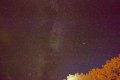
image.jpeg Thanks for all the advice everyone.

I think it's starting to dawn on me that the unless I go with a premium professional grade body the majority of my cost is going to be building up a range of quality lenses for whichever path I follow. Even though I've not had a DSLR camera in hand I already know that the G3 is a very unobtrusive system to carry for everyday use and I'd guess that to be the same for all mft cameras. If I buy second hand lenses then if I find them unsuitable I should be able to sell on without losing too much on them.

I know someone who is into astronomy and have asked that next time they go out and about at night if it would be OK for me to tag along. As others in his group also do astrophotography it may give me more of an insight into what it's going to take to get good images with or without a telescope. Obviously there's the whole image stacking and star tracking mounts to acknowledge yet. I guess I was a bit naive to think that my first milkyway images were going to be anything other than poor. I dare say that is going to a common theme across anything I'm going to try with a camera!
 
Back
Top