AI Bill in UK ping pong between commons and lords

Rincewind

Suspended / Banned
Messages
969
Name
Mark
Edit My Images
No
so -
A government consultation proposes AI developers should have access to all content unless its individual owners choose to opt out.

But nearly 300 members of the House of Lords disagree with the bill in its current form.

They think AI firms should be forced to disclose which copyrighted material they use to train their tools, with a view to licensing it.

Sir Nick Clegg, former president of global affairs at Meta, is among those broadly supportive of the bill, arguing that asking permission from all copyright holders would "kill the AI industry in this country".

So Mr Clegg, in effect thieves should be allowed to take anything they want for their own use and gain and then owners can ask for it back if they are not happy their work has been stolen and used without payment? hmm are you by any chance involved in AI development and will benefit from it?
 
whoever wins the race for AI wins big, if we in the UK want to stifle AI then fair play.
The race is being won by the Chinese and the USA .
The UK is pathetic when it comes to red tape piled on top of more restrictive practices for business.
 
On the BBC R4 'You & Yours' programme to day there was an item where they looked at the use of 'AI shopping' i.e. the growing development of AI Chat Bots to help folk with buying and hence purchase decisions.

One expert's contribution in part covered to quote the host of the show...."was if you are putting your data in to get an answer the AI is learning about you i.e. your data".
The expert pointed out that yes of course that is the case but many retailers involved in the AI will offer discount incentives and the expert said that that could/would/does sway the user decision about 'my data' i.e. (my words not hers) the buyer is getting something exchange for the data by choice :thinking:
 
On the BBC R4 'You & Yours' programme to day there was an item where they looked at the use of 'AI shopping' i.e. the growing development of AI Chat Bots to help folk with buying and hence purchase decisions.

One expert's contribution in part covered to quote the host of the show...."was if you are putting your data in to get an answer the AI is learning about you i.e. your data".
The expert pointed out that yes of course that is the case but many retailers involved in the AI will offer discount incentives and the expert said that that could/would/does sway the user decision about 'my data' i.e. (my words not hers) the buyer is getting something exchange for the data by choice :thinking:

That's been happening for years now with Social Media and even in shops and supermarkets for much longer than you can imagine. We know they are harvesting our data and using it for targetted advertising or selling it on but we still use Social media. We are getting the free use of their platform in exchange for our data.

To be honest I couldn't care less who profiles me on my buying habits. I think I'm savvy enough to buy what I want/need when and if I want/need it. I'll do my research into a new product before buying and I'm aware of the shills on Social media so do take much of that content with a pinch of salt.
 
Perhaps the simplest solution is along the lines of "OK, Mr AI developer, you can use copyright material for training but if you do so your software and all results, must be open source".

After all, geese and condiments, eh? ;)
 
AI needs big data; in some cases it needs detail, in others it just needs metadata. There's no problem with metadata really, although the media don't understand what it is, but I do think where an AI bot is being trained to be creative, the sources should be both licensed and acknowledged just like applies when books include a bibliography. If a medical AIbot is researching cures for cancer, it should have the metadata for all NHS and other patients - but this is not identifiable because it's metadata. It should also have all the existing research data from experiments, again acknowledging the sources and references, but that shouldn't prevent such data being used as it's already published. So I do think that there isn't a one size fits all solution to this issue. Thus the Bill will be tested in court ultimately to establish what is really ok and what isn't, on a case by case basis, as is the norm in English law.
 
Thus the Bill will be tested in court ultimately to establish what is really ok and what isn't, on a case by case basis, as is the norm in English law.
I was talking to a friend who trained in law about this exact point the other day. He summarised it as "we can't decide if it's illegal or not - do what you want and you may or may not go to prison". Which when you put it like that isn't exactly a stable base to invest time and money on.

There are 2 huge problems here
  1. If we don't allow it, others will and the end result will be the same but without the UK getting any of the pie
  2. Many AI "developers" don't actually know how their models work - so they probably couldn't comply with the proposed law even if they want to.
To some limited extent, training your models on copyrighted work is a bit like an aspiring author reading all the best selling books in their genre. You really would expect them to do it.
 
Your analogy about writers is a good one, applying to fiction; but when applied to non-fiction, plagiarism is subject to litigation related to copyright and IPR theft (as we see in the music industry from time to time, albeit only involving those with deep pockets).
It has long been the case the the lack of a written constitution and the aversion to having a system like the French Napoleonic one makes the legal system in the UK an ass, only available to those who can afford recourse to the law (in the civil courts that is).
In relation to AI, I feel sure the developers know very well how their systems work - if they don't, they are not very bright. It's fundamentally simple: take a shedload of data and look for recurring patterns in it. Synthesise those patterns into a set of rules, which are then finessed over time by exercising the algorithms using those rules to generate data, comparing the outcomes to past outcomes and accepted new ones. I couldn't possibly understand how you codify that, but as a conceptual design that's the baseline.
 
In relation to AI, I feel sure the developers know very well how their systems work - if they don't, they are not very bright.
I wish I were as confident as you, on that subject.

I have all too vivid memories of thousands of lines of "C" where the putative coder turned out to have copied huge chunks of other peoples' source. In fact, the coder had not the slightest idea of what the code actually did and when challenged had only one response: "read the code yourself". I spent a lot of time doing just that and making it do what the client wanted, rather than doing what the original author had (correctly, in fact) intended.

If a similar approach has been used with AI code, it's time once again to say...

View: https://www.youtube.com/watch?v=sxqvwkmTNy8
 
Last edited:
@AndrewFlannigan I should perhaps have included a "should" in my quoted sentence! What you describe is my fundamental concern with modern developers - many do not actually know how computers work, really. All they can do is assemble chunks of code taken from other systems and insert code library calls. There's a big difference between that and the design and creation of unique code as you've described yourself doing, and which I did back in the 70's and 80's in various languages. All the emphasis on getting children to do "coding" is fine, but in many cases all they are doing is piecing together chunks of utility code. I have seen good IT teaching in schools, using Python and PHP, but those are pretty high level languages, whereas an understanding of assembler or even microcode, would enable people to appreciate code efficiency.
Irrespective of the foregoing, I find I'm tending to agree with you that it is quite likely that some AI developers are just putting chunks of existing utility code together to do certain tasks. That won't ultimately end well if users become reliant on it.
 
This is a good listen for background https://www.bbc.co.uk/programmes/m002c3bm

I've always been in two minds about the extent of copyright itself. If I make a cupboard and sell it to a cafe owner, I don't get paid every time they open the cupboard doors, or every time a customer cones into the cafe, I get paid once for my time and materials. I do agree that the creator of a work should have the right to control copying.

If I read some books and then write a book which is influenced by the books I have read, I don't have to declare which books I read and pay a license to those authors. It seems to me that it is the same for AI.
 
Last edited:
Many AI "developers" don't actually know how their models work
Of course they know how they work, how could anyone develop software without knowing how it works? What is not necessarily "known" is the exact combination of probabilities which produced a given output from a particular prompt.

As for legislation, we saw a similar thing in the early days of search engines, traditional news outlets tried to get paid for linking to their content. When that didn't work they opted for Pay Walls, but you often notice that they allow the search engines through to index the content and then charge us to view it, which seems contrary to their original objective of getting paid buy the search engine operators.
 
...many do not actually know how computers work, really.
That is, regretably, all too true.

I was lucky, in that I was too poor to buy an Apple, Commodore Pet or Tandy TRS80, so I started with an Acorn System 1. That meant soldering the bits together and learning Boolean math, as well as more about register modes than any sane person ought. A side effect was, when I started to learn high level languages, I already understood the vital need for decent documentation, if I wanted to use other peoples' code.

Of course they know how they work, how could anyone develop software without knowing how it works?
Sadly, on evidence from umpteen years debuging other peoples' work, it seems that they do not.
 
Last edited:
If I read some books and then write a book which is influenced by the books I have read, I don't have to declare which books I read and pay a license to those authors. It seems to me that it is the same for AI.
If it's fiction you are writing, correct. if you are writing a thesis or other academic paper, or reference article/essay/paper, you need to provide both references and bibliography. There may be no exchange of royalties in cash terms, but a sort of in-kind payment exists in the form of that acknowledgement.

I think the point alluded to by @JonathanRyan above regarding not knowing how models work, is perhaps identifying what I would call "anarchic AI", ie a coded model where outcomes are unpredictable - that may be because they are deliberately random because of the lack of identifiable patterns in the learning data, or because they are experimental - we take a bunch of random datasets, do a code version of the 52-card shuffle, and see what comes out, and then decide whether we like it. I like the idea of experimental "anarchic AI" because it creates new paradigms of behaviour that make us challenge our norms. Exciting stuff.
 
I think the point alluded to by @JonathanRyan above regarding not knowing how models work, is perhaps identifying what I would call "anarchic AI", ie a coded model where outcomes are unpredictable - that may be because they are deliberately random because of the lack of identifiable patterns in the learning data, or because they are experimental - we take a bunch of random datasets, do a code version of the 52-card shuffle, and see what comes out, and then decide whether we like it. I like the idea of experimental "anarchic AI" because it creates new paradigms of behaviour that make us challenge our norms. Exciting stuff.
A little of that. But also there are 2 even more exciting factors at play now
  1. There are a whole new breed of vibe coders who really do have no idea what they are doing - or at least how they are doing it.
    One of the Data Scientists at work hacked together a web app in about half an hour despite knowing nothing about how to write them or the languages they are written in. Apparently it works though I haven't heard what the webdevs though of it :)
  2. We reached a point a little while ago where AIs could cobble together perfectly functional code. Since then, advances have been rapid. I would be extremely surprised to learn that companies are doing anything other than using their AIs to write new, better AIs. Just like I could write a program that can play better chess than I can, people can write a program that can write better programs than they can. And then just rinse and repeat until nobody knows how it works.
    It won't be long (in fact it may have happened) before AIs write code in languages that no human knows.
Re crediting reference work....if I design a database then of course I'm influenced by the fact that I read Kimball's book on this years ago - even if only for patterns that no longer work. But I'm not going to credit him in a pull request.
 
Aaah...Bachus Naur Form... my how I hated writing a compiler in that.
 
To be executable, all code must be machine code which can be disassembled and understood.
You mean like I could disassemble Call of Duty Black Ops 6 and understand it?

I mean yeah, theoretically.........it might take a while though.
 
if you are writing a thesis or other academic paper, or reference article/essay/paper, you need to provide both references and bibliography
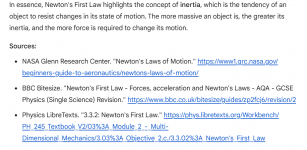
Which is, of course why AI's are so useful for University assignments (... Google Gemini, but other AI's do the same)

1749399862375.png
 
The point about copyright and plagiarism is valid here I think, for works of fiction too. If I wrote a book about Larry Niven's Ringworld and used that name in the book I would be sued. And if I wrote the same book about a ribbon-like structure around a sun peopled by various kinds of hominids with similar technology then I would also be sued for plagiarism, even though I didn't use the same name.

The thing with AI is that it can ONLY plagiarise. It will never travel to Poole harbour or Glencoe, and any images it produces of those places or descriptions it generates can only come from the work of others. The only thing it can do is to break them down, combine them with others and rearrange them so they look new and unique (or sometimes not so much).

So we have to decide if that's ok.

In a sensible society, we might choose to put value on genuine human activity, so that AI would have it's place doing useful things and creative people still got money and recognition for their work. The danger is that we all see cheap as good and free as best, ditching the creatives in favour or the regurgitated stuff. So as intelligent people, we might make AI music worthless by shunning it, but of course marketing and fashion industries are likely to resist THAT. I see the problem as being a human one - will we buy (very cheaply, at least for now) the synthetic stuff or pay more for the real thing.

I wonder how many people on the forum have PU leather items?
 
Last edited:
Back
Top