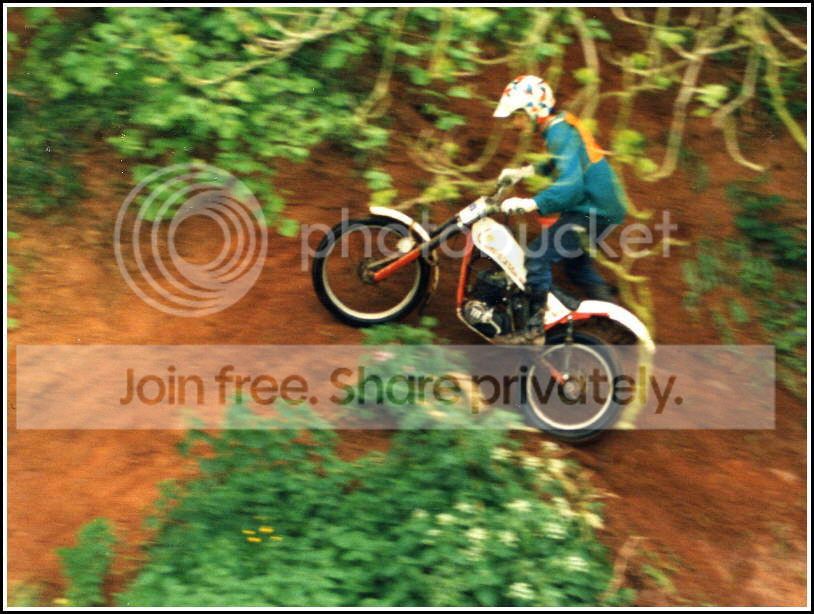
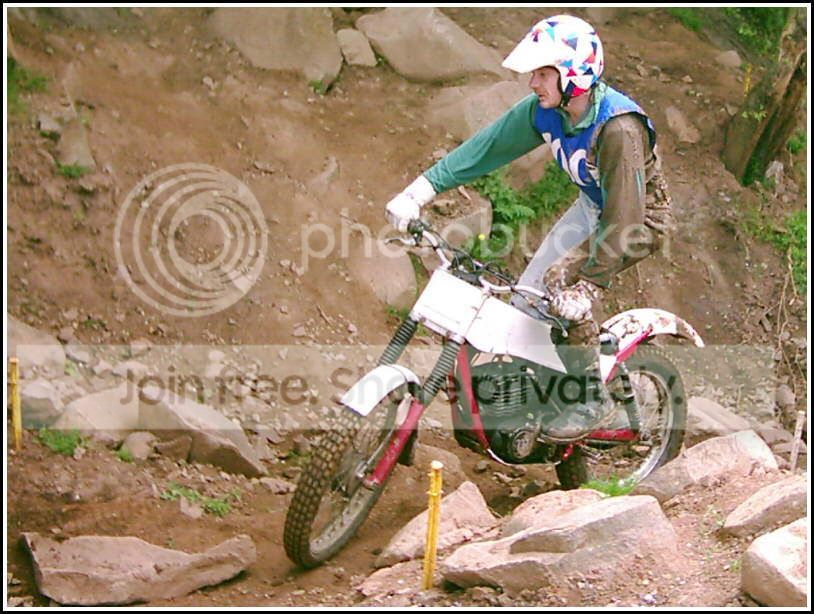
I started doing trials when I was 15... twenty years later I was almost 'proficient' at novice level!

Daftly I have very few pictures of the persuit, and even fewer of me doing it! Well, its rather difficult to wield a camera while trying to balence on one wheel on a 45 degree scree slope, really!
KNOW YOUR SUBJECT - always good advice for any photography. If you dont know what you are looking at, how do you know how best to snap it?
This may help with some basics:
Try Trials
Theres some links in there to the ACU hand-book, which explains things like course lay-out, scoring and stuff, also a bt about the different genres of trials.
Essential stuff; its NOT a race. You have a deviousely laid out obsticle course, called a section; typically, around 50 yards long or so, and riders have to ride that 'section' between 'gates' marked with flags or commonly pegs, and not fall off, put a foot down or miss a gate, under the gaze of an 'observer' who scores them. There will usually be around a dozen sections on an event, to make a 'lap' and riders will have to ride them perhaps three or five times to complete the 'course'. And there ought only be ONE competitor attempting any one section at any one time.
That's the simple stuff; but stuff you maybe ought to know. At a typical club event; first there will rarely be enough observers. Good form, if you are there as a spectator... when volunteers are required.... volunter to score a section, leave the snapping till next time, if you have to. If they dont have observers, they dont have an event, no event, you dont get picks. And observers tend to get a beer or a bottle of wine for thier toruble at the end of the day, and its still 'good form' for competitors to ride the course after doing all thier laps, checking they have been scored for all sections and thanking the observer for thier trouble.... even if they have given them dubiouse dabs! Errant snappers, darting about the course are likely to get shouted at, and possibly run over for getting in the way!
So that's first thing. If you go... be prepared to muck in and do your bit for the event. Spectators rarely get charged, you are not a paying guest, so good manners really to offer to do the washing up, if you get the meal for free, that kind of thing.
Next up; good to have an idea of what the riders are doing; Pegs or flags, general rule; red for right, blue for left.... unlike the thugs that do Motorcross, or the loons that tear round on tarmac.... we are expected to have SOME limited inteligence and know stuff like, our left from our right...... well... its not essential.... I can never remember, and some competitors resort to aid memoirs, like having a red throttle grip and blue clutch side grip.... that can work.... I tried it once, used a red brake lever..... yeah, took me three seasons to realise why I was getting so many fives! ..... but you get the idea... if you know what the course markings are, as a snapper at least You, at least, will know where the bikes OUGHT to be heading!
But what are the yellow pegs for? The whites? what about the orange ones? Typical club trial, you will often have duel or even tripple routing, bit like ski-slopes; an 'easy' an 'intermediate' and a 'hard' route, marked through each section. Different classes; will use different routes. In the main contemprary class event for modern machinary, you'll have novices, club-men and 'experts' who will use the relevent route; then you will have the 'over 40's', who as concession to thier age, be allowed to ride the intermediete course, then the classic lads, and the older T-Shocks will probably use the intermediete course, while the old Birt-Bikes get to use the easy, that kind of thing. Conventions for duel or tripple routing CAN vary from club to club, so may be worth checking at sign on.
Which is the next point. Find the sign on point; ask who-ever is registering the riders, when they have a second if you they can send you a results sheet, when they circulate them to club. They may ask you to pay a quid for an envelope and stamp, and get you to leave your address. More up to date clubs may do it by e-mail, others publish results on line, but worth finding out where to get them. Useful later to identify who you have taken pics of...
Nitty gritty for pics. Well, first off cloths; this time of year warm. But also its a mud-sport. Good grip boots are pretty much essential; many conventional road riding motorbike boots lack the sort of grip for getting into and moving around a trials course. We really do often ride thse bikes where mountain goats would fear to tread, good hiking boots are probably a better idea than wellies.
You are used to nature shots, you ought to know that the one place that gives best photo-vantage is bound to be the most bludy down right awkward to get into...same with trials.
Next up kit; again, like nature photo; you are scrambling through undergrowth, over muddy hills, and boggy ground; take whatever precautions to protect 'kit' as are prudent.
Nice thing about trials is you can get up-close and VERY personal with the participants; mentioned on a post asking about MX how close you can get in that, in trials possible to get even CLOSER.
Road-Race event, very formal; spectators penned in, and kept back from teh track by fences and wide run-off areas; MX, you can get a lot closer, there's often just a rope marking teh course, maybe a double string and four or five feet between you and the action.... Trials? Well you COULD be standing on the pigging track six feet infront of the rider AS they attempt the section!
Observers are supposed to ensure that thier section is 'clear' before a rider is invited to enter; but all riders have the right to 'pre-walk' the section, and see what they have to contend with, eye up thier lines and stuff, and even in top level competition, theres often blokes scrambling out the way of bikes!
If you are reletively cautiouse and considerate, and suitably booted, no reason you could not get in and amongst them, though it IS form to ask the observers permission before entering or crrssing thier section.
Bikes are NOT fast. Mine, admittedly is old, but a full 250, with a mere 10bhp, about the power of a CG125 learner bike.... its geared to be only a tad faster than a moped! It has six gears, four of them lower than first on a 125 Super-Dream!
You wont need fast film, fast shutter speeds or fast lenses. And able to get up close and intimate, you probably dont need anything very tele-photo. In fact, if you find you are using anything boardering on 'tele'.... probably implies you ought to move, and get up closer!
With slow moving subjects, youcould get an awful lot of very good shots with a compact camera, just by exploiting getting close.
That was snapped of me, by my eleven year old with cheap digi-compact. (stood with his bigger brother, pressed into observing!)
Red-Rose, lancashire club, based out of manchester and the big wheel of the North-West regional centre, I believe, I have to confess I have never trialed up there; but I understand that they are pretty slick and proffessional, and organise one of the 'classics' of the calendar at national level, the 'Red-Rose' multi-day, long trial. So are pretty well established and fairly slick at organisation.
BUT you will be going to view, a 'Natural-Terain-Trial'... mentioned in the ACU book, there are a few variations of the persuit. Arena-Trials is in-door demonstration riding over man-made courses. Out-Door, or Natural-Terain, is fairly obviousely out-doors, over a more 'natural' terrain course. Mud. Rock. Bog. Mentioned that the Red-Rose is a classic 'long trial'... modern trials generally are all short observed sections; long-trial, can have the 'observed-sections' strung out over a multi-mile cross-country course, with riders expected to possibly event tackle navigational challenges getting between section locations, possibly a few miles or public road apart; where 'pocket-trials' or short section trials, all the sections will be within an area of an couple of acres, a feilds worth, though more likely a wood or old quarrey or something.
Terrain & texture.. you mentioned getting riders expressions; only half the story, and unfortunately for you, for the most part riders will have thier heads down and a lazer stare on a patch of ground perhaps three feet infront of thier front wheel, plotting thier slow course through the section. If you want those expressions you will probably have to get close, and you will have to get low.
But the real challenge, what every-one is trying to beat, is that terrain. THAT is where the photo's are to be found; the juxtaposition of man-made metal and plastic against age worn rock and primeavil ooze!
You want to capture the concentration, on the MINUTE detail, those riders are concentrating on so hard; one solitary log; one small patch of leaf-mould, one bit of moss on a rock.... that's what the riders are looking at, that's what you need to try and capture, to get the essence of the sport.
And nature photography is probably a very good grounding for it....
Good luck and all the best; look forwards to seeing some pics.