

You are using an out of date browser. It may not display this or other websites correctly.
You should upgrade or use an alternative browser.
You should upgrade or use an alternative browser.
Advice needed
- Thread starter Barney
- Start date

OP

Barney
Suspended / Banned
- Messages
- 3,043
- Name
- Wayne
- Edit My Images
- No
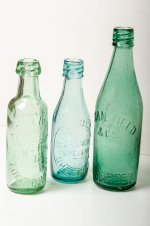
Hi Bazza thanks for your comment,May I suggest thinking about how you are lighting them. Angle of light could make all the difference
currently 45 above table at 45 to subject, I did think 90 from side but the light did not reach all three items

Garry Edwards
Moderator
- Messages
- 13,475
- Name
- Garry Edwards
- Edit My Images
- No
You need a fairly large light source, a softbox is probably ideal, at 90 degrees to the side, with the light just skimming the lettering.
Because of the way that the Inverse Square Law works https://www.talkphotography.co.uk/tutorials/the-magic-of-distance-aka-the-inverse-square-law.164/ you need to get the light as far away as possible 1 1/2 - 2 metres should be OK.
The individual bottles will need to be on different planes, obviously, so that the first one lit doesn't obstruct the light on the second one, and so on, but that shouldn't be a problem. If you think it is, just photograph them separately and comp them together, but that's the hard way of doing it
Because of the way that the Inverse Square Law works https://www.talkphotography.co.uk/tutorials/the-magic-of-distance-aka-the-inverse-square-law.164/ you need to get the light as far away as possible 1 1/2 - 2 metres should be OK.
The individual bottles will need to be on different planes, obviously, so that the first one lit doesn't obstruct the light on the second one, and so on, but that shouldn't be a problem. If you think it is, just photograph them separately and comp them together, but that's the hard way of doing it
OP
Barney
Suspended / Banned
- Messages
- 3,043
- Name
- Wayne
- Edit My Images
- No
Flipping Heck Garry I didn't suppose that far away!
I will have to wait until the Mrs goes to bed and set up in the living room.
Also I will attempt the longer lens further away scenario to mitigate the offset planes.
If I have the three offset and within the depth of field is compression assured?
I will have to wait until the Mrs goes to bed and set up in the living room.
Also I will attempt the longer lens further away scenario to mitigate the offset planes.
If I have the three offset and within the depth of field is compression assured?
Garry Edwards
Moderator
- Messages
- 13,475
- Name
- Garry Edwards
- Edit My Images
- No
Well, it's all about lens to subject distance of course, but if there's enough distance - and more distance will increase DOF - then yes, compression should take care of the differing distances.Flipping Heck Garry I didn't suppose that far away!
I will have to wait until the Mrs goes to bed and set up in the living room.
Also I will attempt the longer lens further away scenario to mitigate the offset planes.
If I have the three offset and within the depth of field is compression assured?
OP
Barney
Suspended / Banned
- Messages
- 3,043
- Name
- Wayne
- Edit My Images
- No
I am really struggling to get the look I am trying to achieve, I have a lack of space that is preventing me from trying out as many light positions as possible.
I have changed the background and that has improved things a bit. This is my best attempt so far.
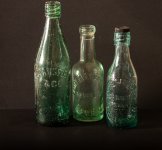
I think that I will be trying a couple of flags next. The light is getting behind and in front even though eight feet off.
I have changed the background and that has improved things a bit. This is my best attempt so far.
I think that I will be trying a couple of flags next. The light is getting behind and in front even though eight feet off.

sk66
Suspended / Banned
- Messages
- 9,557
- Name
- Steven
- Edit My Images
- Yes
I would probably go for dark field backlighting with this subject; and it would probably need more of a V arrangement with the taller bottle in the middle. Pretty sure @Garry Edwards has a lighting challenge covering that elsewhere here.
Might also try straight up backlighting if you want the white background. That would rely on the different thicknesses/contours to refract the light differently to make the letters visible.
Might also try straight up backlighting if you want the white background. That would rely on the different thicknesses/contours to refract the light differently to make the letters visible.
Last edited:
Garry Edwards
Moderator
- Messages
- 13,475
- Name
- Garry Edwards
- Edit My Images
- No
Compared to your first shot, where everything was wrong, it's brilliant!
Forget the background, which is a separate subject anyway, you now have good definition of the lettering, which was the most important point.
And, guessing now, but I think that the colours are now probably about right, and even if they're not, easily improved.
Which leaves us with some options for improvement.
1. A fairly small point, but I think that the camera is still a bit too high
2. The light is too high, it needs to be lowered to the point where it NEARLY but not quite lights the bottle tops, I can't be certain (because it's not me who's lighting it, but lowering the light a bit should remove the unwanted specular reflections on the upper part of the bottles, or at least reduce them.
3. Move the light further back, to the point where it only just skims across the front, showing the definition of the lettering, and further reducing (or at least changing the amount of) unwanted specular highlights. This will increase the backlighting effect, which is something that I feel will be a good thing. By all means try to achieve a similar result by using flags, but my guess is that you don't need them.
4. If possible, get the light even further away, the ISL is still causing problems at this distance.
5. Change to a smaller softbox, if you have one, it may be worse but should be better, but a smaller one will require more precise positioning.
6. Try using a standard reflector instead of a softbox, this will be a more dramatic change that either works or not, and will require very precise positioning.
I wonder whether anyone else has any different ideas?
Forget the background, which is a separate subject anyway, you now have good definition of the lettering, which was the most important point.
And, guessing now, but I think that the colours are now probably about right, and even if they're not, easily improved.
Which leaves us with some options for improvement.
1. A fairly small point, but I think that the camera is still a bit too high
2. The light is too high, it needs to be lowered to the point where it NEARLY but not quite lights the bottle tops, I can't be certain (because it's not me who's lighting it, but lowering the light a bit should remove the unwanted specular reflections on the upper part of the bottles, or at least reduce them.
3. Move the light further back, to the point where it only just skims across the front, showing the definition of the lettering, and further reducing (or at least changing the amount of) unwanted specular highlights. This will increase the backlighting effect, which is something that I feel will be a good thing. By all means try to achieve a similar result by using flags, but my guess is that you don't need them.
4. If possible, get the light even further away, the ISL is still causing problems at this distance.
5. Change to a smaller softbox, if you have one, it may be worse but should be better, but a smaller one will require more precise positioning.
6. Try using a standard reflector instead of a softbox, this will be a more dramatic change that either works or not, and will require very precise positioning.
I wonder whether anyone else has any different ideas?
Garry Edwards
Moderator
- Messages
- 13,475
- Name
- Garry Edwards
- Edit My Images
- No
I would probably go for dark field backlighting with this subject; and it would probably need more of a V arrangement with the taller bottle in the middle. Pretty sure @Garry Edwards has a lighting challenge covering that elsewhere here.
Might also try straight up backlighting if you want the white background. That would rely on the different thicknesses/contours to refract the light differently to make the letters visible.
Darkfield lighting is probably a very good approach, and a low-powered version of brightfield lighting may work too, as long as there isn't any unwanted lettering or other mouldings on the back of the bottles.
The lighting challenges are all very well, and I hope that they encourage people to understand the physics, they are basically just simple tools that everyone should have in their toolbox, but they're limited.
Real-world, we tend to use them as part of a lighting solution, not ususally as the whole solution. With this type of subject I feel that either may help, but should be used in combination with the side lighting (which is really just hard lighting) that I suggested, and which has worked pretty well.
I don't think that I've ever written about having each item on a separate plane, so that each item gets its own lighting, then compressing the differences in positioning by photographing from a greater than normal distance, that's basically just experience - it's a technique that I will have used thousands of times without a moment's thought, but again a useful tool.
Last edited:
OP
Barney
Suspended / Banned
- Messages
- 3,043
- Name
- Wayne
- Edit My Images
- No
I am using a 105mm macro, probably not the correct choice, I have plenty reflectors which I can try.
The lack of flipping space and maneuverability is frustrating me.
Living room is full of lights.
I know the camera is too high but was just trying for the look rather than an anywhere near finished image.
The lack of flipping space and maneuverability is frustrating me.
Living room is full of lights.
I know the camera is too high but was just trying for the look rather than an anywhere near finished image.
Last edited:
Garry Edwards
Moderator
- Messages
- 13,475
- Name
- Garry Edwards
- Edit My Images
- No
I've spent most of my working life with a very large, black studio with loads of lighting.I am using a 105mm macro, probably not the correct choice, I have plenty reflectors which I can try.
The lack of flipping space and maneuverability is frustrating me.
Living room is full of lights.
I know the camera is too high but was just trying for the look rather than an anywhere near finished image
I now have 2 very different homes, there's loads of space when I'm at the farm, but zero time for photography there.
My other address is a tiny flat, loads of time but no space - and yet I make it work, not only have I shot all the lighting challenges in my living room, I've also shot the associated videos there. It's fairly normal for either a light or the camera to be on the wrong side of an open door, to make the space workable, and if I can manage in this space, so can you
 .
.I actually believe that having to manage has helped me, it makes me think more.
OP
Barney
Suspended / Banned
- Messages
- 3,043
- Name
- Wayne
- Edit My Images
- No
Thats Brilliant!
I will move the dining room table so that I can light from the kitchen and open the front window and lean in for the snap.
Could have a chance later in the week, Mrs is trying to cook Sunday dinner, kids are up down for snacks, dogs running in and out.
Meanwhile I am turning the air blue,
" be careful, dont knock that flipping light over"
I will move the dining room table so that I can light from the kitchen and open the front window and lean in for the snap.
Could have a chance later in the week, Mrs is trying to cook Sunday dinner, kids are up down for snacks, dogs running in and out.
Meanwhile I am turning the air blue,
" be careful, dont knock that flipping light over"
Last edited:
sk66
Suspended / Banned
- Messages
- 9,557
- Name
- Steven
- Edit My Images
- Yes
I think the skimmed hard light would work well combined with dark field; which tends to leave the front/center darker. My perceived issue with the skimmed light with this subject is that the texture is on a heavily curved surface, which means you can't really sidelight/skim much of it.With this type of subject I feel that either may help, but should be used in combination with the side lighting (which is really just hard lighting) that I suggested, and which has worked pretty well.
OP
Barney
Suspended / Banned
- Messages
- 3,043
- Name
- Wayne
- Edit My Images
- No
The light seems to go inside and comes out as reflections or mini prisms on the other side where the writing is.
The words at lower portion where I cant take advantage of the reflections due to the thick bottom of the bottles is barley legible
The words at lower portion where I cant take advantage of the reflections due to the thick bottom of the bottles is barley legible
Garry Edwards
Moderator
- Messages
- 13,475
- Name
- Garry Edwards
- Edit My Images
- No
Well, glass - like all other materials - has properties that inevitably create refraction when light passes through them, that's inevitable and unavoidable, but although we can't change the immutable laws of physics, we can bend them by arranging both the lighting and the shooting angle. We can also reduce or mitigate the refraction by reducing the intensity of the light source that creates the problem. This is basically what I meant when I said, perhaps worded badlyThe light seems to go inside and comes out as reflections or mini prisms on the other side where the writing is.
The words at lower portion where I cant take advantage of the reflections due to the thick bottom of the bottles is barley legible
Real-world, we tend to use them as part of a lighting solution, not ususally as the whole solution. With this type of subject I feel that either may help, but should be used in combination with the side lighting (which is really just hard lighting) that I suggested, and which has worked pretty well.
Or, in other words, we need to experiment, if necessary combining different lighting techniques, until we're happy with the result. If I had your subject in front of me I might be able to work it out, but my solutions, when I have them, are based on a mix of physics and experience, and I simply don't have the skills to communicate it in writing.
So, just post an example of the effect you're getting, and I'm sure that some of us will be able to make suggestions.
OP
Barney
Suspended / Banned
- Messages
- 3,043
- Name
- Wayne
- Edit My Images
- No
Well, glass - like all other materials - has properties that inevitably create refraction when light passes through them, that's inevitable and unavoidable, but although we can't change the immutable laws of physics, we can bend them by arranging both the lighting and the shooting angle. We can also reduce or mitigate the refraction by reducing the intensity of the light source that creates the problem. This is basically what I meant when I said, perhaps worded badly
Or, in other words, we need to experiment, if necessary combining different lighting techniques, until we're happy with the result. If I had your subject in front of me I might be able to work it out, but my solutions, when I have them, are based on a mix of physics and experience, and I simply don't have the skills to communicate it in writing.
So, just post an example of the effect you're getting, and I'm sure that some of us will be able to make suggestions.
Garry, there is nothing wrong with your wording or your communication skills.
If it was a plain bottle your excellent advice would have it sorted by now, I have an odd subject and trying for three is not helping. You would have it cracked in a flash with the subject at your disposal.
I will over the next day or two take over the dining room table and make a larger studio, I am also thinking of chucking in a couple of smaller speedlight rather than elinchrom.
Garry Edwards
Moderator
- Messages
- 13,475
- Name
- Garry Edwards
- Edit My Images
- No
Well, unless we're professionals who have to photograph whatever the client wants, there's little point in shooting really simple subjects, we learn far more from the difficult ones.
My advice - keep it as simple as possible. Each additional light adds greatly to the problems, and stick with your studio flashes - speedlights are incredibly useful, but their small size and fixed reflectors add unnecessary complications.
My advice - keep it as simple as possible. Each additional light adds greatly to the problems, and stick with your studio flashes - speedlights are incredibly useful, but their small size and fixed reflectors add unnecessary complications.
sk66
Suspended / Banned
- Messages
- 9,557
- Name
- Steven
- Edit My Images
- Yes
Yes, that is the idea behind the backlighting techniques I suggested. And other things may be tried as well, such as putting reflective foil under each bottle to increase the light transmission there.The light seems to go inside and comes out as reflections or mini prisms on the other side where the writing is.
But as Garry said, it's best to start with one approach/light that gets you a result you like; and then add other lights/tricks to resolve what is lacking. And with really complicated subjects/goals, sometimes compositing is the easy answer.
OP
Barney
Suspended / Banned
- Messages
- 3,043
- Name
- Wayne
- Edit My Images
- No
What is compositing please?Yes, that is the idea behind the backlighting techniques I suggested. And other things may be tried as well, such as putting reflective foil under each bottle to increase the light transmission there.
But as Garry said, it's best to start with one approach/light that gets you a result you like; and then add other lights/tricks to resolve what is lacking. And with really complicated subjects/goals, sometimes compositing is the easy answer.
Taking several individual photos and combining them in a tool such as Photoshop (or in the darkroom, if you were shooting film).What is compositing please?