


Scooter
Suspended / Banned
- Messages
- 625
- Name
- Owen
- Edit My Images
- No
These tests are focused on lighting on location - particularly when competing with the sun when you need to light your subject, in order to get a good sky for example. This is the only time I really stress lights as in the studio I can control the ambient light level. Light arriving at your subject is the important metric, as opposed to light generated at the source. This is impacted by the efficiency of the reflector/lens (on the light), and the area it focuses that light into. My typical use case is to light a single human figure, and so as long as the light pattern covers that, it's useful.
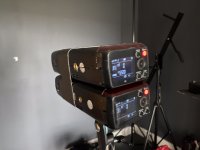
Light output tests for the AD200 with the rectangular Fresnel focused (speedlight type) head, the AD200 with the open curly tube head, with two types of 7" Bowens Mount reflectors, 2xAD200 with the Fresnel head on both and the AD600 with the same reflectors.
Observations
The conical reflector adds around 2/3 of a stop at the centre
The light pattern with the Fresnel head on the AD200 has some variations across it from the lens. The pattern from 2 AD200's is more even. In both cases it is more of a narrow ellipse but does have reasonably graduated falloff. There are extra pieces of light at the extremes from the gaps along the long edge. This is fixed in the MKII AD200-Pro
The output from the AD200 with the Fresnel head is more than the output from the open bulb, with the most efficient reflector. Using a bulb holder like the AD-B2 with its silver face may preserve more light when using a reflector.
The light measured from 2 AD200s with the Fresnel reflectors equals the light measured from the AD600 with the conical reflector, however the AD600 with both the conical and the standard reflector cover a much larger area.
Pick a light shape and efficiency that suits what you need to light.
Light output tests for the AD200 with the rectangular Fresnel focused (speedlight type) head, the AD200 with the open curly tube head, with two types of 7" Bowens Mount reflectors, 2xAD200 with the Fresnel head on both and the AD600 with the same reflectors.
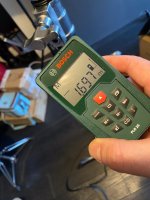
- All lights were set to maximum output. The meter is set to Iso 64, 1/160th to eliminate ambient light. The camera for the pattern shots is also set to Iso 64, 1/160th and f/22. The stand is 1.7m away from the wall. The meter was placed over the white tape for all measurements in the table, although I did scout around to see if the hot-spot was elsewhere (it was always on the tape). I tried various positions for the AD200 with the curly bulb in the S2 grip until I found the optimum position for the bulb in the reflector (further back produces more light with both reflector types)
- Reflector 1 - is the "marketing reflector" favoured by sellers of LED lights, It creates a hotspot in the middle of the pattern. I could actually use this for some styles of shot, but most people will want a more even pattern.
- Reflector 2 - is the standard Lencarta/Godox design that ships with the mains powered studio heads, and gives an even spread with a more graduated falloff at the edges,
| Light | Head | Modifier | Pattern | Meter | Output |
|---|---|---|---|---|---|
| AD200 | Rectangular Fresnel | ---- | 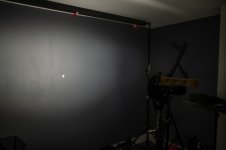 | 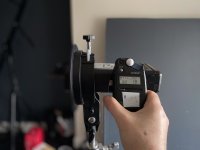 | f/18 with face of light at bulb position. f/20 with face of light at reflector edge position |
| AD200 x 2 | Rectangular Fresnel | ---- | 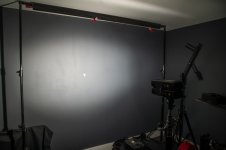 | 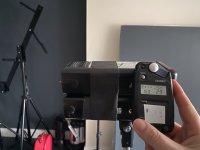 | f/29 |
| AD200 | Open bulb | Conical reflector | 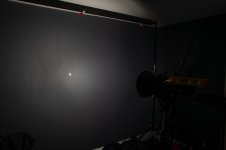 | 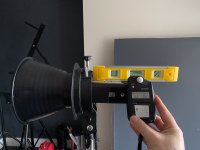 | f/16 |
| AD200 | Open bulb | Standard reflector | 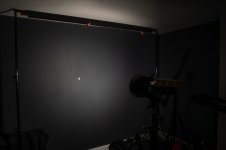 | 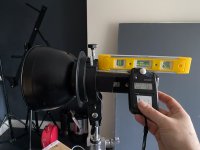 | f/13 |
| AD600 | ---- | Conical reflector | 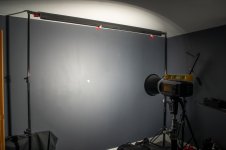 | 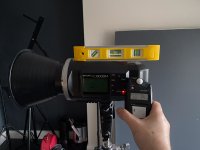 | f/29 |
| AD600 | ---- | Standard reflector | 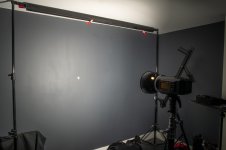 | 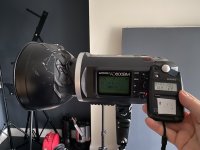 | f/22 |
Observations
The conical reflector adds around 2/3 of a stop at the centre
The light pattern with the Fresnel head on the AD200 has some variations across it from the lens. The pattern from 2 AD200's is more even. In both cases it is more of a narrow ellipse but does have reasonably graduated falloff. There are extra pieces of light at the extremes from the gaps along the long edge. This is fixed in the MKII AD200-Pro
The output from the AD200 with the Fresnel head is more than the output from the open bulb, with the most efficient reflector. Using a bulb holder like the AD-B2 with its silver face may preserve more light when using a reflector.
The light measured from 2 AD200s with the Fresnel reflectors equals the light measured from the AD600 with the conical reflector, however the AD600 with both the conical and the standard reflector cover a much larger area.
Pick a light shape and efficiency that suits what you need to light.
Last edited:

 My aim was more to compare (and so have a constant distance) rather than provide absolute values. The distance from the light source is there or there abouts but does vary due to reflector sizes, physical dimensions of the light head, and mounting solutions. Also - limited by the size and current junk level of the small studio, and a desire to fit the pattern onto the back wall


