A question for bread makers.

woof woof

I like a nice Chianti
Suspended / Banned
Messages
43,206
Name
Alan
Edit My Images
No
This recipe popped up on Youtube so I thought I'd give it a go...

View: https://www.youtube.com/watch?v=v-jilRAZJLU&list=PLyYRFYvEZI86zw-UqHw_RX6lLTiAKuhC9&index=142


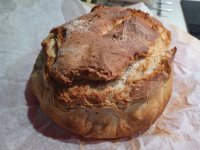
The mixture was way too wet and I had to add more flour but I've seen this before so I assume flour just varies, anyway when baked it turned out very well with a nice crisp crust and I couldn't stop eating it :D I ate some at something between 7 and 8pm and in the morning at something between 8 and 9am I thought I'd make a vegi bacon sandwich but I was disappointed to find that the bread was already passed its best after 12 hours. I haven't seen this fast a deterioration with home made bread before and I just wondered if anyone had an explanation.

I don't know why the vid isn't showing but if you click on the link it should work.
 
Last edited:
The important thing missing is what size of cup
I had a friend who ate my home made bread and decided to buy a bread maker , Off he went with his first loaf
Total disaster , He said it was like porridge , After lots of questions I got to the bottom of his problem
He was using a normal cup , I said you should have a plastic pot in the kit , Indeed he did but did not realise this was the " CUP "
Made the next loaf and it was much better.
 
IMaybe but if the same cup is used throughout the ratios should be the same. I used a standard cup. The sort which comes as a measuring cup with various measurements marked. I have seen this difference in wetness before with recipes on line. I think it is down to different flour in different parts of the world. Once I added flour my dough did look to be the same consistancy of the dough in the video. I don't know what would lead to the bread aging so fast. If I'd made my usual recipe it would have been fine 12 or 13 hours later.

Not to worry. I'm expecting it to make nice toast in the morning.
 
Last edited:
I use a breadmaker just to mix the dough (And first rise) .Then proceed the usual way, cobs (Or your regeonal equivolent. :D) loaves or whatever.
I would regard any "Recipe" as a starting point and find there's a lot more leeway than some would have you believe.
My current "Go Too" is 300g Cotswold Crunch, 200g Strong bread flour, 100g dark rye and 400ml liquid...water, beer or even a standard tin chopped tomatoes!
 
Last edited:
I've been making bread since we got a bread maker as a wedding present so that's just 8 years now. I use the bread maker but also make my own including fruit bread but this is the first time I've had a loaf age so quickly. I'd expect a loaf to be pretty much perfect just 12 or 13 hours later and at the moment I have no idea what the cause is. I might make another using the same recipe and see if by magic it's any different.

The only things missing from this new recipe which I'd normally add are butter, milk powder and sugar. I just wondered if anyone had a clue, I'll see how it goes with the next batch and in the meantime it does make lovely toast. I had a toasted vegi bacon sandwich with brown sauce this morning and it was lovely.
 
Last edited:
I've been making bread since we got a bread maker as a wedding present so that's just 8 years now. I use the bread maker but also make my own including fruit bread but this is the first time I've had a loaf age so quickly. I'd expect a loaf to be pretty much perfect just 12 or 13 hours later and at the moment I have no idea what the cause is. I might make another using the same recipe and see if by magic it's any different.

The only things missing from this new recipe which I'd normally add are butter, milk powder and sugar. I just wondered if anyone had a clue, I'll see how it goes with the next batch and in the meantime it does make lovely toast. I had a toasted vegi bacon sandwich with brown sauce this morning and it was lovely.
No sugar sounds a bit suspicious...isn't sugars reacting with the yeast that gives the rise?
 
No sugar sounds a bit suspicious...isn't sugars reacting with the yeast that gives the rise?

I thought so but the bread made with the recipe above certainly did rise well without it but I've just googled "does sugar help keep bread fresh" and got the following...

"These simple sugars also act as humectants and attract free water, which helps to retain moisture in the bread and slows staling"

"Why Is Sugar Added to So Many Processed Foods? The primary reason sugar is added to so many different foods—including bread—is a combination of shelf life, texture, browning, and taste. Sugar, like salt, acts as a preservative against mold and also helps bread keep its moisture."

So maybe that's the answer. I might make another batch without sugar as per the recipe and then another with sugar and compare the two.

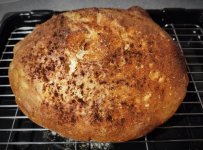
How it turned out. It was lovely when it left the oven but the next morning it wasn't so good. If it can last a couple of days that'd be great.

20250922_192112.jpg
 
Last edited:
All this talk of bread and what goes into takes back many years when I visited (on business) a major brands development kitchen/laboratory.

In chatting with my host, the recipe came up and he spoke of The Chorley Wood method (used by all of the big commercial bakers.

But the kicker that sticks in mind was that he was part of a team tasked with reducing the production costs of the bread and way he was doing it was by increasing the amount of water used......his task was to find that 'inflection point' of max water but no noticeable change in texture & taste.

A little too long ago to recall the actual figures but I think they had gotten to 45% water and hoping to get >50% :cautious: :oops: :$

In other words making it with as much of the very cheapest ingredient as possible:(
 
I suppose we shouldn't be surprised.
 
Alan, if it makes you feel any better, the bread we try to buy doesn't last much over 12 hours from first cut (as bread - the toast after that is great for 2-3 days!)
 
I make a variety of breads by hand, although the dough can be prepared in a bread maker for some recipes.

Bread too wet. For white bread I use extra strong flour (Tesco finest at £1.60 a kilo is brilliant) and between 75% and 100% hydration (ratio of water to flour by weight). A ciabatta needs about 85%, pan de cristal 100%, conventional loaf about 80% and it should stay edible about 3 days. The dough will start wet, but with stretching it will smooth out nicely over a couple of hours proofing.

Brown and granary bread is more difficult, because the dough doesn't smooth and stretch so easily, and remains sticky, even at 75% hydration. Wetting hands can help kneeding/stretching without sticking.

If the bread dries quickly, going stale fast after baking, it may have been baked too long. Adding some protein like eggs can also make the baked product dry faster than expected.

Sugar isn't needed, but it can nake the crust crisper and darker. Adding a tray of water to the oven can help with crisping.
 
Last edited:
We did a 60/40 mix of brown and white (both strong, bread flours) in the machine.
 
Alan, if it makes you feel any better, the bread we try to buy doesn't last much over 12 hours from first cut (as bread - the toast after that is great for 2-3 days!)

Maybe I need to adjust my expectations. I was just surprised as it definitely deteriorated quicker than my usual recipe.

I try not to eat too much bread but when fresh it's hard to resist and this recipe is so easy and very nice when fresh so I probably will give it another go maybe with a different flour. The one above was topped with ground pepper, I might do the same next time.
 
If the bread dries quickly, going stale fast after baking, it may have been baked too long. Adding some protein like eggs can also make the baked product dry faster than expected.

Sugar isn't needed, but it can nake the crust crisper and darker. Adding a tray of water to the oven can help with crisping.

The crust was definitely crispy enough. I don't think it was baked too long but I might try a few minutes less next time but changing too many things might make it difficult to decide what works. I might try changing the flour first and then the time, or I might just go for both :D
 
The crust was definitely crispy enough. I don't think it was baked too long but I might try a few minutes less next time but changing too many things might make it difficult to decide what works. I might try changing the flour first and then the time, or I might just go for both :D

Just watched the video: IMO it could have done with slightly higher hydration (400ml water to 500g flour) and baked for 30min + 10min out of the pot. The hydration has to be kept down because the dough is being handled 'dry' and will be too sticky using this technique of folding on a floured surface with dry hands. The long bake gives a nice crispy crust, but will combine with lower hydration for a shorter shelf life - if you do this again, keep the loaf in a plastic bag after cutting, stored cut-face down, and cut away a thin slice from the cut face of the bread before using the rest of the loaf.

Just making bread tonight: 350g very strong (13% protein) flour, 310ml water, 10g poppy seeds, 5g yeast and 6g salt. Will do the last stretch and fold in a minute, but can't decide whether to make rolls or a single larger loaf. Rolls are nice because the crust tends to seal in the moisture and keep out the oxygen. A loaf is nice for a slice.
 
Just watched the video: IMO it could have done with slightly higher hydration (400ml water to 500g flour) and baked for 30min + 10min out of the pot. The hydration has to be kept down because the dough is being handled 'dry' and will be too sticky using this technique of folding on a floured surface with dry hands. The long bake gives a nice crispy crust, but will combine with lower hydration for a shorter shelf life - if you do this again, keep the loaf in a plastic bag after cutting, stored cut-face down, and cut away a thin slice from the cut face of the bread before using the rest of the loaf.

Just making bread tonight: 350g very strong (13% protein) flour, 310ml water, 10g poppy seeds, 5g yeast and 6g salt. Will do the last stretch and fold in a minute, but can't decide whether to make rolls or a single larger loaf. Rolls are nice because the crust tends to seal in the moisture and keep out the oxygen. A loaf is nice for a slice.

Ta.

I'll give that a go. I do use plastic bags.

It's addictive this isn't it :D

Tomorrow I'm making apple and bramble pies for the church table top sale. They'll be made with brambles picked from my local walk which starts just a couple of 100m from home and apples supplied by one of my neighbours :D

The only thing is that when Mrs WW is home she pushes me out of the kitchen.
 
Last edited:
Ta.

I'll give that a go. I do use plastic bags.

It's addictive this isn't it :D

Tomorrow I'm making apple and bramble pies for the church table top sale. They'll be made with brambles picked from my local walk which starts just a couple of 100m from home and apples supplied by one of my neighbours :D

The only thing is that when Mrs WW is home she pushes me out of the kitchen.

Addictive isn't quite right, but I've made pretty much all our bread for more than a year because we had problems getting bread locally for a while, and I just never went back to buying it normally.

My wife is the opposite of yours, and sometimes has to move me aside in the kitchen so she doesn't forget how to cook.
 
When she first came to the UK I did all the cooking. She was cossetted and either her mam or the housekeeper did everything but she slowly took an interest and now I get banned from the kitchen.

Slightly off on a tangent. Doing my own cooking has really cut down on both the general and recycling waste. I go quite a while now before needing to put a bin out to be emptied.
 
Last edited:
Yeast doesn't need sugar, it needs sugarS. Although it's common to get quick yeast started with a spoon of granulated, the sugar it needs to make the bread rise comes from the flour.

I suspect the recipe is short cutting this by skipping most of the proving. That's when the flour releases sugars and the yeast gets to work.

Compare soda bread where all you are doing is using bicarb and buttermilk to make the rise. That doesn't last long at all.
 
The crust was definitely crispy enough. I don't think it was baked too long but I might try a few minutes less next time but changing too many things might make it difficult to decide what works. I might try changing the flour first and then the time, or I might just go for both :D


Change one variable at a time.
 
My standard recipe is 300g wholemeal, 200g strong white, 1 tsp salt, 2tbsp olive oil and 330ml water plus the yeast

My understanding is the fat (olive oil) helps with the keeping qualities but softens the crust slightly
 
My standard recipe is 300g wholemeal, 200g strong white, 1 tsp salt, 2tbsp olive oil and 330ml water plus the yeast

My understanding is the fat (olive oil) helps with the keeping qualities but softens the crust slightly

Oils apparently also reduce gluten formation, but a lower hydration leaves the dough stiffer, and that compensates helping the dough hold its shape when rising. Addition of yoghurt can also give a softer, longer lasting crumb.
 
It's alchemy!
 
I just can't make my own bread. Not because I don't understand the "alchemy" but I just enjoy bread to much.

My diabetic nurse suggested I cut down on the bread I eat. I asked what was the point of getting through two lots of cancer and a heart attack if I can't enjoy the things I love. I don't have as much as I used to have.
 
Oh dear. Sorry about that munch but at least cutting these things out keeps you around :D
 
Back
Top