50mm equivalent lens for micro four thirds

inquisitive_chap

Suspended / Banned
Messages
118
Edit My Images
No
I am reading @Garry Edwards excellent book "Do you want to learn Digitial Photography" [Which I recommend to any beginners. I still regard myself as one!]

I have a Micro Four Thirds camera and it comes with a pancake lens (14-42mm). I was reading the section about training yourself not to use the zoom lens and that using a 50mm lens or equivalent (so 25mm in my case), and using your feet to zoom in and out, can be useful at first

Obviously I can just manually set the zoom to 25mm. But I was wondering about buying my first 'extra lens'. I realise at my level, the limiting factor is me rather than the lens, but I figured it wouldn't be a bad investment anyhow as the lens would work with any future camera I bought (not that I am planning on upgrading for a good while)

Any recommendations for good micro four thirds 25mm (or thereabouts) lens?
 
Last edited:
The zoom lens gives you so much flexibility, that I would always recommend its use to any beginner.

However, if you feel that you really want to use one, I'd recommend the "standard" lens from the same manufacturer as the camera.
 
Incidentally, the MFT system seems good to me as the cameras are small and light. I read somewhere there was some concern manufacturers may abandon them now full-frame mirrorless are out. But is that a needless worry? Are they here to stay for a while? I don't want to buy a lens if they then die out!
 
I don't want to buy a lens if they then die out!
If a camera can provide the images you want, it's never obsolete.

I'm still geting useful pictures from digital cameras that are twenty years old.
 
Incidentally, the MFT system seems good to me as the cameras are small and light. I read somewhere there was some concern manufacturers may abandon them now full-frame mirrorless are out. But is that a needless worry? Are they here to stay for a while? I don't want to buy a lens if they then die out!

That idea has been put to rest, they are here for some time yet, even if the manufacture stopped today !
 
The Panasonic 20mm f/1,7 is a classic MFT lens

it's this one.................... LUMIX G 20mm Micro 4/3 Single Focal Length Lens - Silver
 
Last edited:
I am reading @Garry Edwards excellent book "Do you want to learn Digitial Photography" [Which I recommend to any beginners. I still regard myself as one!]

I have a Micro Four Thirds camera and it comes with a pancake lens (14-42mm). I was reading the section about training yourself not to use the zoom lens and that using a 50mm lens or equivalent (so 25mm in my case), and using your feet to zoom in and out, can be useful at first

Obviously I can just manually set the zoom to 25mm. But I was wondering about buying my first 'extra lens'. I realise at my level, the limiting factor is me rather than the lens, but I figured it wouldn't be a bad investment anyhow as the lens would work with any future camera I bought (not that I am planning on upgrading for a good while)

Any recommendations for good micro four thirds 25mm (or thereabouts) lens?
As above, to get 50mm equivalent on m4/3 you need a 25mm, you just need to halve the full frame focal length.

I personally don't buy into the idea of not using a zoom lens. I can see the pros and cons for each arguement, but for me I think a zoom is better for a beginner for a few good reasons. Firstly it allows you a greater scope of what you can acheive, and it teaches you about how focal length affects perspective and field of view.

I understand that due to the 'limitations' of prime lenses it pushes you to look for other ways to take a shot and there is some merit in that, however I personally think it's better to learn the basics of perspective, field of view etc first after which you can then go out and use a single focal length to push you out of your 'comfort zone' (when using zoom lenses it's easy to fall into the 'trap' of always using wide angle for landscapes for example).
 
I am reading @Garry Edwards excellent book "Do you want to learn Digitial Photography" [Which I recommend to any beginners. I still regard myself as one!]

I have a Micro Four Thirds camera and it comes with a pancake lens (14-42mm). I was reading the section about training yourself not to use the zoom lens and that using a 50mm lens or equivalent (so 25mm in my case), and using your feet to zoom in and out, can be useful at first

Obviously I can just manually set the zoom to 25mm. But I was wondering about buying my first 'extra lens'. I realise at my level, the limiting factor is me rather than the lens, but I figured it wouldn't be a bad investment anyhow as the lens would work with any future camera I bought (not that I am planning on upgrading for a good while)

Any recommendations for good micro four thirds 25mm (or thereabouts) lens?
You don't need to buy a prime lens, self-discipline achieves the same result at no cost:)

The whole idea is to zoom with your feet rather than with the lens. What this means is that you should walk around, moving closer, further away and obviously to different angles, so that you take the shop from the position that creates the best result. Most beginners just use the zoom instead of doing that, taking the shot from what is usually the wrong position, just because the zoom allows them to.

I personally don't buy into the idea of not using a zoom lens. I can see the pros and cons for each arguement, but for me I think a zoom is better for a beginner for a few good reasons. Firstly it allows you a greater scope of what you can acheive, and it teaches you about how focal length affects perspective and field of view.
Focal length has ZERO effect on perspective, which is entirely dependent on lens to subject distance.
 
Focal length has ZERO effect on perspective, which is entirely dependent on lens to subject distance.
Well yes, I just didn’t want to over complicate things with them being a beginner (y)

For the OP’s benefit what we mean by this is that perspective changes with distance to the subject and generally the wider the lens you use the closer to the subject you are and vice versa which is why (incorrectly) people say focal length changes perspective. I hope this isn’t too confusing.
 
You don't need to buy a prime lens, self-discipline achieves the same result at no cost:)


And if/when that runs out, an inch of gaffer tape "locking" the zoom at the chosen focal length helps reinforce the discipline!
 
Focal length has ZERO effect on perspective, which is entirely dependent on lens to subject distance.

But it is hard to convince people of that (as it stands) when for example I sit in my chair with a 25mm lens and take a photo of the end of the room, the walls are vertical and straight, but simply stay where I am and change to a 7mm lens, and the walls are straight, but sloping with what is normally referred to as perspective distortion.
 
Thanks

That looks good value too!

The M.Zuiko Digital ED 20mm F1.4 PRO which I have seen recommended in some reviews seems too pricey for someone starting out

Yes, it is good value.
Mine focuses down to 8cm instantly even in a room lit by one lamp (just tried it on a coin to check, I had forgotten)

Minor issues from reviews don't make a significant difference, and are not normally noticeable. All are fixable very quickly in post.
I have not noticed the distortion in use, I will have to wait for daylight to double check. However it is unfair to compare that aspect with OEM lenses, as distortion is automatically corrected in camera with them. Again, if there is any, once you have corrected it once and saved the profile, it is just one click to select your saved profile to correct.

I have taken photos into the sun, and at night with bright street lights, and there is very little flare, and occasional fringing (again removed very quickly).

I don't notice the slight corner softness wide open, there are usually other things to notice, but it has sharpened up by f2.8, and that still gives you a stop over a normal zoom.

Yes, spending 4-5 times as much will buy a better lens, and would be worth it for a professional whose photos pay for their lenses.

Overall, it is very good (it is still sharp as lenses go) and will do as well or better than the average zoom, especially in low light and depth of field
 
I bought a Panasonic/Lumix 25mm 1.7 recently. £75 on eBay which I don’t think is untypical in terms of what you can pick them up for. Total bargain at that sort of money especially compared to the slightly slower Olympus equivalent (had one of those a while ago too). I have the 20mm 1.7 ii as well which I love but they’re a lot more money and very slow AF. So I’d highly recommend giving the 25mm 1.7 a try.
 
You don't need to buy a prime lens, self-discipline achieves the same result at no cost:)

The whole idea is to zoom with your feet rather than with the lens. What this means is that you should walk around, moving closer, further away and obviously to different angles, so that you take the shop from the position that creates the best result. Most beginners just use the zoom instead of doing that, taking the shot from what is usually the wrong position, just because the zoom allows them to.


Focal length has ZERO effect on perspective, which is entirely dependent on lens to subject distance.
This is good advice. I shall exercise self discipline for now

Ps. @Garry Edwards , although you allowed me to have a copy of your e-book some time ago, I have only just read it (my enthusiasm for photography waned as I got a bit lost in complexities, and I've only just returned). It is, truly, a very excellent book
 
I bought a Panasonic/Lumix 25mm 1.7 recently. £75 on eBay which I don’t think is untypical in terms of what you can pick them up for. Total bargain at that sort of money especially compared to the slightly slower Olympus equivalent (had one of those a while ago too). I have the 20mm 1.7 ii as well which I love but they’re a lot more money and very slow AF. So I’d highly recommend giving the 25mm 1.7 a try.
I think that was an excellent price, the ones I see are normally a bit more, 100-110.

I also have 20 1.7, but I rare use it for anything that moves fast, so the slower focus speed doesn't worry me
 
Incidentally, the MFT system seems good to me as the cameras are small and light. I read somewhere there was some concern manufacturers may abandon them now full-frame mirrorless are out. But is that a needless worry? Are they here to stay for a while? I don't want to buy a lens if they then die out!

I don't think there is any danger of that. If anything I think it's going the other way. Both Panasonic, and OM Systems have played a blinder the last few years. And, it does appear to me that more photographers are taking them up. Largely swayed by the size and versatility of the system. Hats off to manufacturers of M4/3 cameras for giving people what they want.
 
I think that was an excellent price, the ones I see are normally a bit more, 100-110.

I also have 20 1.7, but I rare use it for anything that moves fast, so the slower focus speed doesn't worry me

I'd say it's still a steal at that sort of money when you compare to other options. Very nice little lens.

I probably prefer the images from the 20mm overall, they have a certain look to them but it's quite a different focal length, a fair bit more money and as you say, AF is slow. I really like how compact it is but I do carefully choose my uses for that one.
 
But it is hard to convince people of that (as it stands) when for example I sit in my chair with a 25mm lens and take a photo of the end of the room, the walls are vertical and straight, but simply stay where I am and change to a 7mm lens, and the walls are straight, but sloping with what is normally referred to as perspective distortion.
not if you keep the camera back straight.

You’re confused because when you zoomed out, your image contained loads of floor and it felt wrong. So you tilted the camera, that created the ‘perspective distortion’.

I’m gonna rock your world and tell you there’s no such thing as ‘perspective distortion’. What you know as perspective distortion (converging verticals) is literally the effect of tilting your camera, not related to focal length or subject size, purely the photographer doing the ‘obvious’ thing of tilting the camera to capture tall buildings. And like ‘wide angle distortion’ is a repetition of what our eyes do as well. Not a lens or even photographic phenomena, purely viewing angle
 
not if you keep the camera back straight.

You’re confused because when you zoomed out, your image contained loads of floor and it felt wrong. So you tilted the camera, that created the ‘perspective distortion’.

I’m gonna rock your world and tell you there’s no such thing as ‘perspective distortion’. What you know as perspective distortion (converging verticals) is literally the effect of tilting your camera, not related to focal length or subject size, purely the photographer doing the ‘obvious’ thing of tilting the camera to capture tall buildings. And like ‘wide angle distortion’ is a repetition of what our eyes do as well. Not a lens or even photographic phenomena, purely viewing angle

Not confused, just saying it is hard to convince people as the statement stands, and showing how the misunderstanding/belief can easily come about.

I often straighten 30-50 photos at a time for my daughter for properties they are selling, and guess what the tool in the software is called (Affinity? (Gemstone and GIMP, no idea about PS, don't use it)

I would suggest that the "distortion" spoken about would be easier to understand if explained as the effect of the ratio of the distance between the the lens and subject of the closest part of the subject, and the furthers part, and this ratio decreases as the overall distance from the subject increases. Keeping the same area in the frame, you would closer with a wider angle lens, so the difference in the distance between the top and bottom would be greater, so the effect would be greater than if you were far away and the distances were almost the same.
(or some similar description)

I did not say the statement was incorrect, just that as it stands it is open to misunderstanding.
 
Last edited:
Not confused, just saying it is hard to convince people as the statement stands, and showing how the misunderstanding/belief can easily come about.
It probably read more personally than I’d intended.
And you’re right, the phrase is commonly used incorrectly all over photography.

Just occurred to me that what Canon calls a ‘tilt-shift’ lens, Nikon calls a Perspective Control lens.
 
It probably read more personally than I’d intended.
And you’re right, the phrase is commonly used incorrectly all over photography.

Just occurred to me that what Canon calls a ‘tilt-shift’ lens, Nikon calls a Perspective Control lens.
I didn't take it the wrong way :)


Yes, which is why people (not only beginners) get confused, or may not be confused, but understand different things from the same words.

Perspective correction, or the lens control can be correct, perspective involves lines converging to a vanishing point, so altering the angle, or eliminating it could be both correction and control.
 
Just did some very quick tests with the Lumix 25 1,7 and the Yongnuo 25 1.7

Both are good, autofocus (essential for me) feels instant on both.

Wide open the Lumix is slightly sharper, more noticeably in the centre. The Yongnuo catches up about f4. The ISO was high, which would not help..

The Lumix seems a bit wider, as if the Yongnuo is about 27mm

I was comparing a section about 1/5 of the width and height (so 1/25th of the area), but looking at the whole frame on the whole screen, it is hard to see the difference, and why would you normally want to crop something anything like that much instead of changing lenses?
 
Last edited:
I’m gonna rock your world and tell you there’s no such thing as ‘perspective distortion’. What you know as perspective distortion (converging verticals) is literally the effect of tilting your camera, not related to focal length or subject size, purely the photographer doing the ‘obvious’ thing of tilting the camera to capture tall buildings. And like ‘wide angle distortion’ is a repetition of what our eyes do as well. Not a lens or even photographic phenomena, purely viewing angle

I'm late to this so I don't know if the OP will read this or not.

Another point on perspective. I don't like the expression "zoom with your feet" as it doesn't work as if you change the camera to subject distance by walking forward or backwards the perspective changes but if you stand in one place and zoom it doesn't.

You don't even need a camera to be able to see these effects.

I am a prime lover though and if you spend enough time with one you'll soon know what perspective and framing you want and where to stand to get it.
 
Another point on perspective. I don't like the expression "zoom with your feet" as it doesn't work as if you change the camera to subject distance by walking forward or backwards the perspective changes but if you stand in one place and zoom it doesn't.

You don't even need a camera to be able to see these effects.

I am a prime lover though and if you spend enough time with one you'll soon know what perspective and framing you want and where to stand to get it.
I agree with your general point, but personally I understand "Zoom with your feet" simply to mean "use your feet, not a zoom lens". That's a simplistic doctrine, it doesn't mean "Prime lens good, zoom lens bad", it's often the right thing to do to use a zoom lens, but it does make sense (if it doesn't mean walking off the edge of a cliff) to walk to the spot that produces the best shot rather than take the easy, lazy way out and just zoom. It's that simple.

I'm ancient enough to remember the time when we didn't have zoom lenses - OK, the Zoonar 36-82/2.8 came out in about 1959 but it was both terrible and horribly expensive - but when I could afford my first zoom lens I found that I just became lazy, and my compositional quality went right down.
 
Another point on perspective. I don't like the expression "zoom with your feet" as it doesn't work as if you change the camera to subject distance by walking forward or backwards the perspective changes but if you stand in one place and zoom it doesn't.
Me an all
But I didn’t want to upset @Garry
 
I agree with your general point, but personally I understand "Zoom with your feet" simply to mean "use your feet, not a zoom lens". That's a simplistic doctrine, it doesn't mean "Prime lens good, zoom lens bad", it's often the right thing to do to use a zoom lens, but it does make sense (if it doesn't mean walking off the edge of a cliff) to walk to the spot that produces the best shot rather than take the easy, lazy way out and just zoom. It's that simple.

I made no comment regarding primes or zooms being either good or bad. We have to make our own choices.

I do think that "zoom with your feet" is misleading and I think we should if at all possible avoid using the term. I think the best way to use a zoom is to position yourself for the perspective you want and then set the zoom length to get the framing. There are of course times when you can't move and only have the option of zooming regardless of the perspective. Birds and planes in flight, fences and cliffs and the end of piers etc. limiting us. I think perspective is one of the things people should strive to get to grips with and understand as it does have a huge impact on the final look of the picture.

An example I've used before.

Image I have a 28-200mm lens and I'm taking a picture of Mrs WW. It's a half body shot of Mrs WW in front of an interesting thing. A building, tree, thing... It doesn't matter what it is, it's in the distance behind her.

I start at 28mm and then I back up and take pictures at 35, 50, 85, 100 and finally 200mm and then at 200mm distance I reset the zoom to 28mm and take another shot. In each picture apart from that last 28mm shot Mrs WW is always the same size in the frame and it's always a half body shot because that's what we're going for. When we look at the pictures we see that although Mrs WW is in the same position and is the same size the look of the background changes. In the first 28mm picture we see that Mrs WW looks relatively big and the interesting thing behind her looks relatively small but as we back off through the focal lengths and get to 200mm distance the background thing gradually looms over Mrs WW. We then notice one final thing. When we crop the final 28mm picture so that it's a half body shot we see that perspective wise it looks nothing like the first 28mm shot and instead looks like the 200mm shot.

We can see this without a camera. When out and about look at the scene. There may be a row of lamp posts heading off down the road into the distance until the bend in the road and at the corner there may be a pub with a hill behind it in the far distance. As we look into the distance we see that the pub and the hill behind it are much taller than that last lamp post but with every step down the road we take we see the last lamp post before the corner getting bigger in our view and then all of a sudden it looks taller than the pub. Meanwhile the hill has somehow shrunk and we can't see it behind the pub. I think this is why it's important to know that camera to subject distance affects the perspective but zooming or rather focal length / angle of view if you like does not but both of these things should be considered if we care about framing and perspective in our pictures.

Sorry to go on but maybe that helps someone, somewhere :D
 
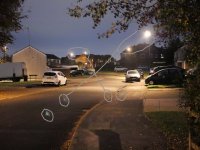
Couple more observations between the Lumix 25 1,7 and the Yongnuo 25 1.7

When taking close-ups (I was using berries on hawthorn to test) the Yongnuo will focus at half the distance the Lumix does, and focuses more reliably, the Lumix very often needs several button presses to focus.

Also, a UV filter is not a good idea on the Lumix lens, as seen in the photo. It is n there when the filter is taken off.
Does not happen on the Yongnuo.
Also, the halo around the lights is much much less on the Yongnuo. It is still the same on the Lumix when the UV filter is taken off

It was much darker to the eye than the photo suggests.

Lumix 25 + UV.jpg
 
Last edited:
Couple more observations between the Lumix 25 1,7 and the Yongnuo 25 1.7

When taking close-ups (I was using berries on hawthorn to test) the Yongnuo will focus at half the distance the Lumix does, and focuses more reliably, the Lumix very often needs several button presses to focus.

Also, a UV filter is not a good idea on the Lumix lens, as seen in the photo. It is n there when the filter is taken off.
Does not happen on the Yongnuo.
Also, the halo around the lights is much much less on the Yongnuo. It is still the same on the Lumix when the UV filter is taken off

It was much darker to the eye than the photo suggests.

View attachment 465753

I've noticed the lumix does flare a lot. I don't mind a little flare sometimes but I don't think it's pleasing at all with the Lumix. A hood would probably help but I don't think there is an official one available.
 
I've noticed the lumix does flare a lot. I don't mind a little flare sometimes but I don't think it's pleasing at all with the Lumix. A hood would probably help but I don't think there is an official one available.
I have a hood, but I would use it for what there is a bright light off to one side, this is coming straight it, I don't think a hood would help.

But the reality is there are good and bad points for both lenses, but I would use the Yongnuo at night :)
 
Woof woof, spot on with that breakdown - the Mrs WW example really nails how distance shapes the whole feel of a shot, way more than just tweaking the focal length. I've leaned on my 25mm prime a ton for wedding portraits on MFT, especially in those crammed ceremony spots where you can't back up much. At one outdoor gig last fall, shifting just a couple feet from the couple made the background trees frame them perfectly instead of crowding in, and it saved me from heavy cropping later. Totally agree it's worth experimenting with to get that perspective dialed in early.
 
Back
Top